









Siemens SSA, SKB, SAY and SAS Actuator Series: A Technical Guide
Siemens actuators are among the most commonly specified in Australian commercial HVAC and building automation systems. The SSA, SAS, SAY, and SKB series cover the dominant damper and valve control applications — from compact VAV box dampers through to large AHU mixing boxes and modulating chilled water coil valves. Each series has a defined application domain; selecting the correct series avoids field rework and ensures the actuator meets the mechanical and control requirements of the application. Specifying a damper actuator with insufficient torque, or a linear valve actuator where a rotary actuator is needed, will result in either field failure or a costly replacement during commissioning.
This guide covers the technical characteristics of each series, the model number decoding logic for the HVAC actuator range, actuator sizing methodology, and the key selection criteria for Australian commercial projects. Fail-safe behaviour — which series and variants offer spring return, and in which direction — is addressed specifically, as this is a common source of specification errors and non-compliance with damper actuator requirements under AS 1668 and the National Construction Code.
Series Overview
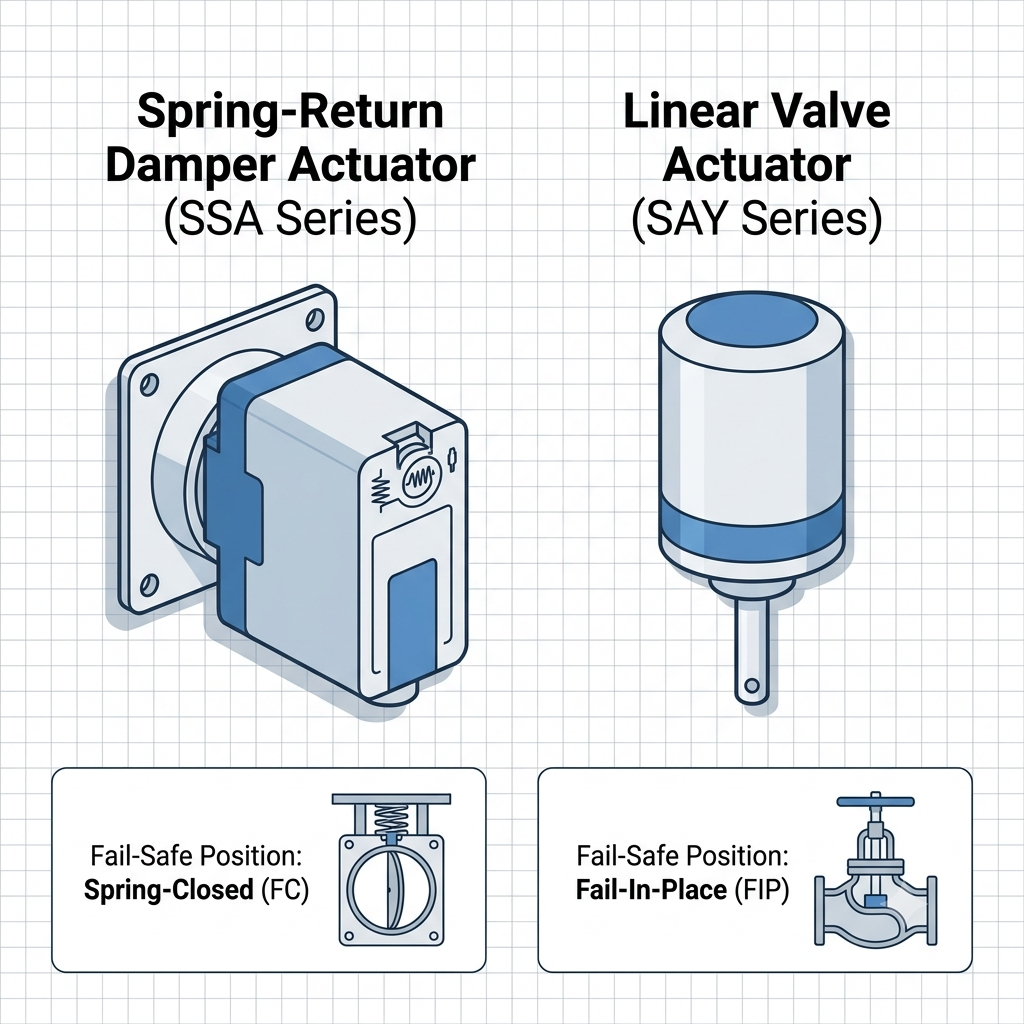
| Series | Application | Motion | Spring Return | Typical Torque / Force | Key Applications |
|---|---|---|---|---|---|
| SSA | Dampers | Rotary | Yes | 3–45 Nm | Outdoor air dampers, exhaust dampers, AHU mixing boxes, economiser dampers, relief dampers |
| SAS | Dampers | Rotary | Yes | 2.5–10 Nm | VAV terminal unit dampers, small HVAC zone dampers |
| SAY | Valves (globe) | Linear (push-pull) | Yes | 300–800 N | 2-way and 3-way globe valves on AHU cooling and heating coils |
| SKB | Valves (ball/butterfly) | Rotary (quarter-turn) | Optional | 10–150 Nm | Ball valves, butterfly valves, isolation and modulating applications on larger pipe sizes |
All series are available through Controls Traders as an authorised Siemens distributor for South Australia and nationally.
SSA Series — Spring-Return Damper Actuators
The SSA series is Siemens' primary line of spring-return rotary actuators for air-side damper applications. Spring return is the defining attribute of the series: the electric motor drives the actuator toward its operating position while simultaneously compressing a mechanical spring. On loss of power or control signal, the spring drives the actuator to a defined fail-safe position without requiring any external power or control input. This behaviour is a code requirement for outdoor air dampers under AS 1668.2 (to close and isolate the air stream in cold climates, preventing freeze damage to heating coils) and for any damper serving a life safety function under AS 1668.1.
The SSA range spans the torque requirements of most commercial HVAC damper installations. Key torque classes within the range include:
- SSA31 — 3 Nm: suited to small VAV box dampers and compact duct-mounted dampers up to approximately 0.3 m² area with standard blade seals.
- SSA61 — 10 Nm: the most widely used SSA variant in Australian commercial projects. Appropriate for medium commercial dampers of approximately 0.6–0.8 m² with standard parallel or opposed blades and moderate sealing requirements.
- SSA81 — 25 Nm: for larger AHU mixing box dampers and economiser dampers where damper area, blade count, or tight low-leakage seals require higher torque.
- SSA161 — 45 Nm: the highest-torque variant in the standard SSA range, suitable for large relief and exhaust dampers on major air handling plant.
Control signal variants are identified in the model number by a two-digit decimal suffix:
- .03 — on/off (two-position), 24 V AC/DC. The actuator drives fully to the open position when energised and spring-returns to fail-safe when de-energised. Used for simple two-position control (open/closed) without intermediate positioning.
- .53 — three-point floating. The BMS sends open and close pulse commands; the actuator drives in the commanded direction for the duration of the pulse. Used with floating output controllers or thermostats that do not have an analogue output.
- .73 — 0–10 V proportional modulating. A continuous analogue input signal positions the actuator proportionally across its 0–95° rotation. This is the standard variant for BMS analogue output control.
Fail-safe position must be specified separately from the torque class and control variant. SSA actuators are available as normally-closed (NC — spring drives the actuator to the closed position on power loss, standard for outdoor air dampers and mixed-air dampers) or normally-open (NO — spring drives the actuator to the fully open position, used for relief dampers and exhaust dampers where opening on power loss prevents over-pressurisation). Confirm the required fail-safe direction with the mechanical engineer or BAS contractor before ordering.
Many SSA models support integral or field-fitted auxiliary switches — end-of-travel feedback contacts that close when the damper reaches the fully open or fully closed position. These dry contact outputs provide a binary position proof signal to the BMS, which is essential in fire/smoke control sequences where the BMS logic must confirm damper position before permitting a fan to start. The presence and configuration of auxiliary switches is identified in the suffix codes of the full model number.
SAS Series — Compact Spring-Return Actuators
The SAS series serves small dampers and VAV terminal unit applications where the physical dimensions of the SSA actuator exceed the available mounting space in the unit. The torque range of 2.5–10 Nm covers single-blade and small multi-blade dampers typically found inside VAV boxes and small duct-mounted zone dampers. The mounting arrangement — shaft clamp geometry, bracket profile, and overall actuator footprint — is designed to fit the smaller damper shafts and mounting configurations found in manufactured VAV terminal units from major HVAC manufacturers.
Control variants in the SAS series parallel those in the SSA: on/off, three-point floating, and 0–10 V modulating variants are available, with spring return as standard. The selection between SSA and SAS for a given application is primarily determined by physical fit — damper shaft diameter, available mounting depth, and the space envelope inside the terminal unit or duct section — rather than by control or torque characteristics alone.
SAY Series — Linear Spring-Return Valve Actuators
The SAY series drives valve stems in a linear (push-pull) motion, making it the correct actuator type for globe valves with a rising stem. Globe valves are the predominant valve type on AHU chilled water and hot water coils in Australian commercial HVAC systems, as their flow characteristic (typically equal-percentage) is well-matched to coil heat transfer behaviour. Spring return in the SAY provides fail-safe valve positioning — fail-closed is standard for heating and cooling coil valves, ensuring that the coil valve closes on power loss and prevents uncontrolled heating or cooling of the conditioned space.
Key technical specifications for the SAY series:
- Stroke: 5.5 mm standard. This is directly compatible with the Siemens VVI, VVF, and VXF globe valve body series, which are designed around the same stroke.
- SAY31 — 300 N force: suitable for DN15 to DN32 globe valves on secondary chilled water and heating water circuits at standard HVAC differential pressures. This is the most commonly selected SAY variant for AHU coil valve applications.
- SAY61 — 800 N force: required for valves on primary circuits with higher differential pressure, larger DN valve bodies, or where system pressure fluctuations require a higher close-off force margin.
- Control input: 0–10 V modulating is standard. Versions accepting 4–20 mA input are available for applications where the BMS analogue output is current-based.
- Mounting: integral bracket provides direct coupling to the Siemens VVx valve series. Adapter kits are available for mounting to compatible third-party valve bodies — stem travel compatibility with the 5.5 mm stroke must be confirmed before specifying an adapter.
Close-off pressure verification is a critical step in SAY selection. The actuator closing force must exceed the hydraulic force acting on the valve disc at maximum system differential pressure. The required close-off force (N) can be estimated as: Kvs (m³/h) × system ΔP (kPa) × a valve-type factor. For most secondary HVAC circuits at standard ΔP, the SAY31 at 300 N provides adequate close-off force for DN15–32 globe valves. Verify against the valve manufacturer's published close-off force data for the specific valve and system pressure combination before finalising the selection.
SKB Series — Rotary Valve Actuators
The SKB series drives quarter-turn applications: ball valves and butterfly valves, which require a 90° rotation to move between fully open and fully closed positions. Unlike the SSA damper actuator — which is designed for continuous modulating positioning across a 95° rotation — the SKB's mechanical design is optimised for the torque profile of ball and butterfly valves, which require significantly higher breakaway torque at the start of the opening stroke than running torque during normal modulation.
Spring-return and non-spring-return variants are both available in the SKB range. Spring-return SKB variants are selected for isolation applications where the valve must reach a defined fail-safe position — typically fail-closed for shutoff applications on condenser water or chilled water pipework. Non-spring-return (hold last position) variants are appropriate for modulating applications where the BMS can reliably reposition the valve after a power interruption, and where the fail-safe requirement is to remain in the last commanded position rather than drive to an end-of-travel position.
The torque range of 10–150 Nm in the SKB series covers ball valve and butterfly valve sizes from DN20 through to large-diameter butterfly valves on major plant. Torque selection requires matching the actuator's rated torque to the valve's required breakaway torque at maximum system differential pressure, with a minimum safety margin of 25% above the valve manufacturer's published breakaway torque figure. Breakaway torque for ball valves is typically 2–3 times the running torque; for butterfly valves it varies with disc geometry and seat type.
Decoding Siemens Actuator Model Numbers
Siemens uses a structured part number system for the HVAC actuator range. Reading the model number correctly is essential for confirming a specification and for identifying replacement parts in the field. The general structure is:
- First two characters — series identifier: SS = spring-return rotary (damper), SA = spring-return linear or non-spring-return linear/rotary (actuator), SK = rotary/ball valve actuator.
- Third character — application variant: A = rotary damper actuator (SSA/SAS), Y = linear valve actuator (SAY), B = rotary/ball valve actuator (SKB).
- Digits (e.g., 31, 61, 81, 161) — force or torque class: higher numbers indicate higher rated torque (Nm) or force (N). These do not directly correspond to the rated torque value — they are class designators. Refer to the Siemens HVAC product catalogue for the torque or force value associated with each class designator within each series.
- Decimal suffix (e.g., .03, .53, .73) — control input type: .03 = on/off two-position (24 V AC/DC), .53 = three-point floating (open/close pulse), .73 = 0–10 V modulating proportional input.
- Trailing letter codes — options: S = integral auxiliary switch (end-of-travel feedback), U = universal voltage (accepts 24–240 V AC/DC on a single model), A1 = 4–20 mA input variant.
Two practical examples illustrate the decoding:
- SSA61.73: Spring-return, rotary, damper actuator (SSA series), 10 Nm torque class (61), 0–10 V modulating proportional input (.73). No auxiliary switch, standard 24 V AC/DC supply.
- SAY31.53: Spring-return, linear, valve actuator (SAY series), 300 N force class (31), three-point floating control input (.53). Suitable for AHU coil globe valves controlled from a floating output thermostat or BMS.
For engineers and technicians familiar with Belimo actuator model numbers, the naming philosophy differs — Belimo encodes product family, torque, and options differently — but the underlying approach of reading torque class, signal type, and spring-return status from the part number is similar. The Controls Traders article on Belimo model numbers explained covers the Belimo decoding methodology for comparison.
Actuator Sizing Guide
Correct actuator sizing prevents both field failure (undersized actuator cannot overcome damper or valve resistance) and unnecessary cost (oversized actuator is larger and more expensive than required). A systematic approach reduces the likelihood of specification errors.
Damper actuators (SSA and SAS series):
Required torque (Nm) = Damper area (m²) × Specific torque (Nm/m²)
Typical specific torque values by damper type:
- Parallel-blade dampers, standard seals: 8–12 Nm/m²
- Opposed-blade dampers, standard seals: 10–16 Nm/m²
- Dampers with tight low-leakage blade seals (Class 1 or Class 2 leakage to AS 4117): 15–20 Nm/m²
Apply a minimum 25% safety margin to the calculated torque to account for manufacturing tolerances, seal ageing, and blade linkage wear over the actuator's service life. Where the damper manufacturer publishes a required actuator torque specification, use that value — with the 25% margin applied — in preference to the area-based calculation. Select the next standard SSA or SAS torque class above the calculated requirement.
Linear valve actuators (SAY series):
Required force (N) must equal or exceed the valve's close-off force at maximum system differential pressure. This is published in the valve datasheet as a "required actuator force at rated ΔP" figure for Siemens VVI/VVF/VXF valves. The SAY31 at 300 N covers the majority of AHU coil valve applications on secondary HVAC circuits at standard design differential pressures. Where the calculation indicates a required force approaching the SAY31 rating, specify the SAY61 (800 N) to maintain an adequate margin at maximum system pressure transient conditions.
Rotary valve actuators (SKB series):
Required torque (Nm) ≥ valve breakaway torque at maximum system ΔP × 1.25 safety margin. Ball valve breakaway torque is typically 2–3 times running torque; the exact figure is published in the valve manufacturer's data. Butterfly valve breakaway torque varies with disc geometry, seat material, and the direction of flow relative to disc position — consult the valve datasheet.
For complex selections — particularly where system ΔP varies significantly across operating conditions, or where the damper or valve manufacturer's data is not available — contact Controls Traders for selection support. The Siemens HVAC product catalogue (Catalogue S) provides the full torque and force data for each model in the SSA, SAS, SAY, and SKB series.
Controls Traders stocks the Siemens HVAC actuator range across the SSA, SAS, SAY, and SKB series for Australian commercial projects. For selection assistance, lead time confirmation, or to discuss actuator requirements for a specific project, contact the Controls Traders team.
Frequently Asked Questions
What is the difference between the SSA and SAS series?
Both are spring-return rotary damper actuators for air-side HVAC applications. The SSA covers a wider torque range (3–45 Nm) and offers more control signal variants and auxiliary switch configurations, making it the standard selection for medium and large commercial dampers from approximately 0.3 m² upward. The SAS is more compact in its physical form factor, intended specifically for smaller dampers and VAV terminal unit applications where the SSA's body dimensions do not fit within the available mounting envelope inside the unit or duct section. The selection is primarily determined by physical fit rather than control requirements.
How do I choose between spring-return (SSA) and non-spring-return (SKB non-spring) actuators?
Use spring-return whenever the damper or valve must reach a defined fail-safe position — open or closed — on loss of power or control signal. This is mandatory for outdoor air dampers under AS 1668.2 (fail-closed to isolate the air stream and protect heating coils in cold climates), for fire and smoke dampers under AS 1668.1, and for any isolation valve where fail-safe closure is a safety or process requirement. Use non-spring-return (hold last position) where the fail-safe requirement is to maintain the last commanded position, or where the BMS can reliably reposition the actuator within an acceptable time after power restoration — typically modulating valves on secondary circuits in systems with reliable power supply.
Can SAY actuators be fitted to non-Siemens valve bodies?
Yes. Siemens and third-party suppliers provide adapter kits to mount the SAY series to compatible globe valve stems. Before specifying an adapter, verify two critical parameters: first, that the valve stem travel is compatible with the SAY's 5.5 mm stroke — some globe valves use a different stroke and require a stem nut adjustment or a different actuator entirely; second, that the SAY's force rating (300 N for SAY31, 800 N for SAY61) meets the valve's published close-off force requirement at the maximum system differential pressure. Where neither of these can be confirmed from the valve manufacturer's data, contact Controls Traders for guidance.
How do I decode a Siemens actuator model number?
The first two letters identify the series: SS for spring-return rotary damper actuators, SA for linear or non-spring rotary actuators, SK for rotary ball or butterfly valve actuators. The following letter identifies the application variant: A for rotary damper, Y for linear valve, B for rotary ball valve. The digits (31, 61, 81, 161) identify the torque or force class — higher numbers indicate higher rated values. The decimal suffix identifies the control input: .03 is on/off two-position, .53 is three-point floating, .73 is 0–10 V modulating. Trailing letters indicate options: S for integral auxiliary switch, U for universal voltage (24–240 V AC/DC). The full decoding table is published in Siemens Catalogue S — HVAC Products.
How much torque do I need for a 1.2 m² damper?
Using a specific torque of 12 Nm/m² for a parallel-blade damper with standard seals: 1.2 m² × 12 Nm/m² = 14.4 Nm. Applying a 25% safety margin: 14.4 × 1.25 = 18 Nm. The next standard SSA class above 18 Nm is the SSA81 at 25 Nm, which is the correct selection for this damper. For a damper fitted with tight low-leakage blade seals (Class 1 or Class 2 leakage rating), increase the specific torque assumption to 16–20 Nm/m² and recalculate — in this case the SSA81 at 25 Nm remains the appropriate selection but with a reduced safety margin, and the SSA161 at 45 Nm may be warranted if the damper manufacturer's published torque specification exceeds 25 Nm.
Leave a comment
Popular Posts
Siemens SSA, SKB, SAY and SAS Actuator Series: A Technical Guide
Differential Pressure Sensors for HVAC: A Technical Selection Guide
Belimo Model Numbers Explained: A Practical Guide for HVAC Engineers and Contractors