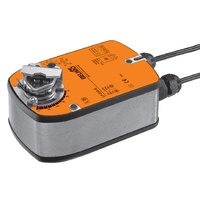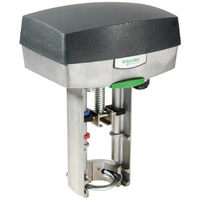









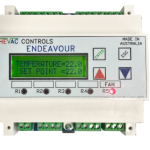
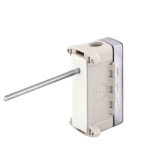
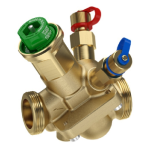
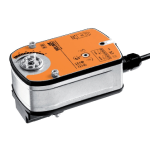
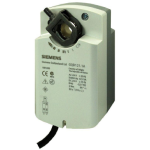


Welcome to Controls Traders, located in Adelaide, South Australia. We are a supplier of quality building automation controls and peripheral products for the HVAC industry. We stock a full range of controllers, sensors, valves and actuators, damper actuators and accessories to suit any application. Our aim is to provide our customers with the highest level of service, from sales to delivery and after sales support. With our extensive in-house knowledge and expertise in the industry, we can advise you on selection and application of our wide range of controls products.

Backed by 40 years industry experience. When you just need to be sure.

No, we’re serious. Anywhere. Anytime.

We stock all major global brands. And if we don’t have it, we’ll find it.

We warehouse the stock so you don’t have to wait.
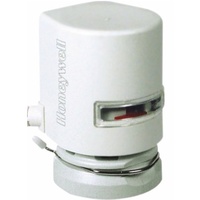
$144.26 $171.75 ex GST
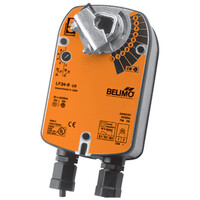
Every damper and control valve in a building automation system depends on an actuator to translate a control signal into physical movement. Get the selection wrong and the symptoms show up everywhere else first — a VAV box that hunts, a valve that won't fully close, a fire damper that fails its annual test — long before anyone traces the fault back to the actuator itself. This guide walks through the five decisions that determine correct actuator selection: load type, torque, fail-safe behaviour, control signal, and supply voltage.
Controls Traders supplies actuators across the Belimo and Siemens ranges to mechanical contractors and BAS integrators throughout Australia. If you'd rather skip straight to brand-specific comparisons, see our guides on Belimo vs. Siemens actuators and the different types of actuators and their applications.
Actuator selection starts with what the actuator is driving, because damper actuators and valve actuators are not interchangeable even when their electrical specifications look similar. Damper actuators are rated in newton-metres (Nm) of rotational torque and typically produce a 90° stroke. Valve actuators are rated either in newton-metres for rotary valves (ball, butterfly) or in newtons of linear force for globe and 2-way/3-way valves with a linear stem, and the stroke length or rotation angle must match the specific valve body.
Undersizing torque is the single most common actuator selection error, and it rarely fails outright — instead the actuator strains against the load, runs hot, and either stalls short of full travel or wears out its gear train early. Oversizing wastes money and, on smaller valve bodies, can accelerate wear on the stem packing or ball seats through excess closing force.
For dampers, manufacturers publish torque-per-square-metre figures that vary by blade type and design velocity — opposed-blade dampers typically need less torque than parallel-blade dampers of the same size, and higher face velocities increase the torque required to overcome air pressure across the blades. Multiply the published torque-per-square-metre figure by the damper's face area, then apply a safety margin (commonly 20%) to account for linkage friction, seal drag, and any bearing wear expected over the actuator's service life.
For valves, the manufacturer's valve datasheet states the maximum torque or force required to operate and close off against the system's differential pressure — always size the actuator to meet or exceed this figure, and confirm the actuator's close-off rating covers your system's maximum expected differential pressure, not just its nominal operating pressure.
| Typical Damper Size | Indicative Torque Class | Common Application |
|---|---|---|
| Up to ~0.5 m² | 2–5 Nm | Small VAV terminal dampers, zone dampers |
| ~0.5–1.5 m² | 5–10 Nm | Standard AHU outside air / return air dampers |
| ~1.5–3 m² | 10–20 Nm | Large AHU mixing dampers, plant room isolation dampers |
| Above ~3 m² | 20–40 Nm or multiple actuators | Large multi-section dampers, often paired with a jackshaft or linked actuators |
These bands are indicative starting points only — always confirm against the specific damper manufacturer's torque table for blade type, seal type, and design velocity before finalising a selection.
Fail-safe behaviour determines what the actuator does when it loses electrical power, and getting this wrong on a life-safety application is a compliance failure, not just an inconvenience.
| Actuator Type | Behaviour on Power Loss | Typical Use |
|---|---|---|
| Spring return | Internal spring drives to fail-safe position (open or closed, as configured) | Fire/smoke dampers, outside air dampers, heating/cooling valves where fail-safe position matters |
| Non-spring return | Holds last commanded position via motor gearing | General VAV, exhaust dampers, modulating loops where fail-in-place is acceptable |
| Electronic fail-safe (capacitor-driven) | Onboard capacitor drives actuator to fail-safe position over several seconds, then holds | Applications needing fail-safe behaviour without the added torque draw of a mechanical spring |
Fire and smoke dampers must use spring return actuators certified for that application — this is a code requirement, not a design preference, and substituting a non-spring return actuator on a life-safety damper is not compliant regardless of torque rating.
The actuator's control signal must match what the BMS controller or field bus is capable of outputting — there is no universal adapter between signal types, so this decision needs to be locked in before ordering.
Supply voltage (typically 24 VAC or 230 VAC, occasionally 110 VAC) must match the transformer or circuit already available at the actuator location — this is usually dictated by the wider BMS design rather than chosen independently for each actuator. Most modern BAS installations standardise on 24 VAC because it simplifies co-locating control and power cabling and is consistent across the analogue and digital actuator ranges of most manufacturers.
Mounting also needs confirmation before ordering: damper actuators need a shaft adapter kit matched to the damper's shaft diameter and shape (round or square), and valve actuators need the correct mounting bracket or direct-coupled adapter for the specific valve body — cross-brand valve and actuator combinations are common but always require checking the manufacturer's compatibility documentation first.
Need help selecting the right actuator for your project?
Controls Traders supplies the full Belimo and Siemens actuator ranges, including spring return, non-spring return, modulating, and BACnet/Modbus variants for damper and valve applications across Australia.
Contact Controls Traders — our technical team can confirm torque, fail-safe, and control signal requirements for your specific application.
For dampers, torque requirement scales with damper area, blade type, and air velocity — manufacturers publish torque-per-square-metre tables for opposed-blade and parallel-blade dampers that you multiply by your damper's face area, then add a safety margin of around 20% to cover linkage friction and seal drag. For valves, required torque or force depends on valve type, size, and the differential pressure the actuator must close against — ball and butterfly valves list a maximum required torque in the manufacturer's datasheet, and the actuator must meet or exceed that figure, including any close-off pressure rating. Always size to the datasheet figures rather than estimating; undersized actuators stall or fail to fully open and close, and oversized actuators waste money and can shorten linkage life through excess mechanical stress.
A spring return actuator stores mechanical energy in an internal spring while driving open under motor power; if electrical power is lost, the spring drives the damper or valve back to its fail-safe position — typically fully closed for fire and smoke dampers, or fully open or closed for valves depending on the failure mode required by the application. A non-spring return actuator has no internal spring and simply holds its last commanded position on power loss, using the motor's own gearing for mechanical holding torque. Spring return actuators are mandatory for life-safety applications such as fire/smoke dampers and are commonly specified for outside air dampers and heating/cooling valves where an uncontrolled failure position could cause coil freezing or energy waste. Non-spring return actuators are typically specified for general VAV, general exhaust, or modulating control loops where a fail-in-place behaviour is acceptable or preferred.
No — supply voltage must match exactly, and 24V and 230V (or 110V) actuators are not interchangeable or field-convertible in almost all cases. Applying line voltage to a 24V-rated actuator will destroy the internal transformer or electronics immediately. The choice of supply voltage is usually driven by the BMS transformer already installed for the zone or plant room — most modern DDC and BAS installations standardise on 24 VAC for actuators and sensors because it is safer to wire, easier to run alongside low-voltage control cabling, and consistent across most manufacturers' analogue and digital control ranges. Line-voltage actuators are more common in retrofit situations where a 230V supply is already at the damper or valve location and running a separate 24V transformer circuit is impractical.
A floating point (also called tri-state or three-point) actuator has no internal positioning electronics — the BMS controller sends short open or close pulses on two separate digital outputs, and the actuator moves incrementally in that direction for as long as the pulse is held, with the controller inferring position from elapsed run time rather than reading actual position feedback. A modulating actuator accepts a continuous analogue signal — typically 0-10 V or 4-20 mA — and drives to a proportional position corresponding to that signal value, using an internal potentiometer or digital position sensor for closed-loop position control. Modulating actuators give more accurate and repeatable positioning and are the standard choice for critical control loops such as AHU cooling and heating valves, while floating point actuators are a lower-cost option still widely used for VAV damper control where BMS controllers are commonly built around tri-state damper outputs.
For a single damper or valve on a conventional analogue or digital output from a local DDC controller, an analogue (0-10 V, 4-20 mA) or floating point actuator is simpler to wire and commission and is entirely fine. BACnet MS/TP or Modbus RTU actuators become worthwhile when you have many actuators on a shared communication trunk, when you need position feedback and diagnostic data (running current, stall detection, hours run) reported back to the BMS without dedicating separate analogue input points, or when the controller itself is a BACnet/Modbus device with no spare analogue outputs. Communicating actuators cost more per unit but reduce field wiring significantly on multi-actuator installations such as VAV risers or large AHU plant rooms, since a single two-wire RS-485 trunk can address dozens of devices rather than requiring an individual home run per actuator.
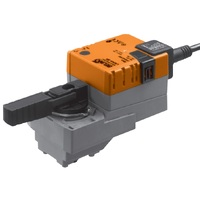
The choice between spring-return and non-spring-return actuators is one of the most consequential specification decisions in HVAC and building automation. These two types behave entirely differently when power is cut or a control signal is lost — and specifying the wrong type can result in freeze-damaged coils, failed fire control sequences, or unnecessary capital expenditure across a large installation.
Selection should be driven by the fail-safe requirement of the specific application — not by habit, default specifications, or cost alone. To make the correct choice, you must understand what happens to the connected damper or valve when power is lost, and whether that outcome is acceptable given the system, its occupants, and the applicable Australian Standards. This guide sets out the technical differences, code obligations, and a practical decision framework for the most common HVAC applications.
A spring-return (SR) actuator uses an electric motor to drive a gear train that rotates the output shaft — and simultaneously compresses an internal coil spring. When the motor is de-energised (power removed, or control signal lost), the compressed spring releases and drives the shaft back to its starting, or fail-safe, position.
Spring-return actuators are available in two fail-safe configurations, which must be specified at time of order:
The fail-safe position is set at manufacture and cannot be reversed in the field. Always specify NC or NO on the purchase order. An important operational characteristic of spring-return actuators is that they draw continuous electrical power at any intermediate modulating position — the motor must continuously counteract the spring force to hold the shaft at positions other than the fail-safe position.
A non-spring-return (NSR) actuator uses an electric motor to drive a self-locking worm gear that positions the output shaft. When the motor stops, the worm gear holds the shaft in position without any motor power — the worm gear geometry prevents back-driving, so air pressure, valve pressure, and gravity cannot move the shaft. On power loss, the result is hold-in-last-position: the shaft remains exactly where it was when power was cut.
Electronic fail-safe (capacitor-return) actuators exist as a variant that offers some of the size and power efficiency advantages of NSR actuators while providing a defined fail-safe position. These actuators store energy in an internal capacitor and, on power loss, use that stored energy to drive to a pre-programmed position. However, this approach relies entirely on the capacitor being functional — periodic testing and capacitor replacement are required to maintain the fail-safe behaviour, and capacitor-return actuators are not to be used in life-safety applications where spring-return is mandated by Australian Standards. For life-safety applications, mechanical spring-return remains the only compliant option.
The power draw of an NSR actuator holding position is less than 0.5 W, compared to 2–5 W continuously for a spring-return actuator holding an intermediate modulating position. In large installations with many actuators, this energy difference is measurable over a year of operation.
| Feature | Spring-Return | Non-Spring-Return |
|---|---|---|
| Fail-safe position | Defined at manufacture (open or closed) | Holds last position (or programmable with capacitor — see note) |
| Code requirement for life-safety | Mandatory (fire/smoke dampers, OA dampers) | Not acceptable for life-safety applications |
| Operating power draw | Higher — motor continuously counteracts spring | Lower — worm gear holds position without motor power |
| Physical size for same torque | Larger — spring housing adds bulk and mass | More compact |
| Capital cost | Higher (typically 30–60% above equivalent NSR) | Lower |
| Mechanical life | Spring fatigue over time; check manufacturer cycle rating | Longer mechanical life in most applications |
| Manual override | Most include pushbutton or hex key override | Most include a manual override |
Spring-return actuators are not an option in applications where a defined fail-safe position is required by Australian Standards or by the consequences of the application. Understanding these requirements before specifying is essential.
Fire and smoke dampers (AS 1668.1, AS 1851): Spring-return is mandatory for all fire and smoke damper actuators. The actuator must drive to the closed position on loss of electrical power or on a trip signal from the fire control panel. Non-spring-return actuators — including capacitor-return variants — are not compliant for this application. Auxiliary switch outputs providing proof-of-closure contacts are also required; confirm the switch configuration (normally-open or normally-closed contact, and the voltage and current rating) against the fire control panel specification before ordering.
Outdoor air dampers in most Australian applications: AS 1668.2 cold-air protection requirements and standard engineering practice require OA dampers to close on power loss in virtually all Australian commercial HVAC applications. This includes temperate climate zones such as Adelaide, Melbourne, and Canberra, where winter temperatures create freeze risk for chilled water coils and heating coils. Spring-return NC is the correct specification for OA damper actuators across the overwhelming majority of Australian commercial projects.
Beyond code obligations, spring-return should also be specified in any application where the consequence of the actuator failing to reach a defined position is operationally significant — including applications where the BMS cannot guarantee a prompt command to the actuator following power restoration, valves on high-pressure steam or high-temperature hot water circuits where an open valve during power failure would be hazardous, and applications in buildings where the BMS has a history of losing control of actuators during power disturbances.
VAV box primary air dampers in most commercial buildings: Hold-in-last-position is acceptable for the primary air damper in a standard VAV terminal unit in commercial office, retail, or education applications. The majority of VAV actuator installations in Australian commercial buildings use NSR actuators. Belimo LM series and Siemens SAS series both offer NSR variants specifically suited to VAV terminal mounting. Where the project specification or brief explicitly requires spring-return on VAV boxes — for example, for specific critical-environment zones — spring-return must be used; but it is not the default requirement for commercial VAV applications.
Modulating mixing box dampers in mild climates: Where freeze protection of coils is not a concern and the system includes independent safeguards (such as a low-limit temperature controller), an NSR actuator on a mixing box return-air or relief-air damper may be acceptable. This requires a documented fail-safe analysis and sign-off from the mechanical engineer responsible for the project — it is not a blanket permission.
Cost-constrained applications with appropriate fail-safe analysis: Where capital cost is a significant project constraint and the application is not life-safety critical, a structured fail-safe analysis demonstrating that hold-in-last-position is an acceptable outcome can support the use of NSR actuators. The analysis must be documented, reviewed by the responsible engineer, and retained as part of the project record.
Interior supply and return air dampers with no life-safety function and no freeze risk: Balancing dampers, zone isolation dampers, and similar interior air-distribution components where the fail-safe position is genuinely immaterial — where neither fully open nor fully closed creates a safety or significant comfort concern — are appropriate candidates for NSR actuators.
Spring-return actuators draw 2–5 W continuously when holding at intermediate modulating positions. For a large installation, this adds up: a building with 200 modulating spring-return actuators averaging 4 W continuous power draw over 8,760 hours per year consumes approximately 7,008 kWh annually. At a commercial electricity rate of $0.25/kWh, this represents around $1,750 per year in electricity costs attributable to actuator holding power — before factoring in cooling load on the air conditioning system.
NSR actuators draw less than 0.5 W holding position. The same 200 actuators consume approximately 875 kWh per year — a reduction of more than 85%. For large projects where NSR actuators are technically appropriate, this energy difference is a meaningful lifecycle cost consideration.
Capital cost differences are equally real. Spring-return actuators typically cost 30–60% more than equivalent NSR models for the same torque output and control type. On a project with many actuators, the capital premium for spring-return over NSR can be substantial — and is only justified where the fail-safe requirement genuinely demands it. Blanket specification of spring-return for applications where NSR is technically acceptable increases project cost without improving system safety or performance.
Spring fatigue over the actuator's service life is a consideration for lifecycle planning. Manufacturers typically rate spring-return actuators for 60,000–100,000 full cycles. An OA damper cycling once per occupied hour accumulates approximately 3,000 cycles per year — implying a spring life of 20–33 years under normal occupied-building conditions. Applications with higher cycle rates, such as demand-controlled ventilation with frequent CO₂-driven resets, will experience spring fatigue sooner. Include planned spring and actuator replacement in the lifecycle maintenance plan for all critical and life-safety applications, as required by AS 1851.
Belimo spring-return variants are identified by the "SR" suffix in the model number (for example, LM24A-SR is the spring-return variant of the LM24A NSR model). This convention applies consistently across the LM, NM, AM, and GM series for damper actuators, and across the valve actuator ranges. NSR models incorporate the mechanical self-locking worm gear that holds position without motor power and cannot be back-driven by air pressure or fluid pressure. Browse the full Belimo product range or see the Belimo model numbers guide for a complete breakdown of the model number structure.
Siemens offers both SR and NSR variants across the SSA series (3–45 Nm, AHU and general HVAC damper applications) and the SAS series (purpose-designed for VAV terminal unit mounting). As with Belimo, the spring-return variants are distinguished by specific model number suffixes — refer to the Siemens actuator series guide for model selection guidance, or browse the Siemens product range on the Controls Traders website.
Contact the Controls Traders team for specification support, fail-safe analysis guidance, or to confirm stock availability for project programmes.
Use this guide as a starting point for each application on a project. In all cases, the responsible mechanical or controls engineer must confirm the fail-safe analysis for the specific application before ordering.
In Australian commercial HVAC, spring-return normally-closed (NC) actuators are required for outdoor air dampers in virtually all applications. When the AHU shuts down, the OA damper must close to prevent uncontrolled cold outdoor air reaching chilled water or refrigerant coils (freeze risk), and to prevent uncontrolled building pressurisation or air quality degradation. AS 1668.2 cold-air protection requirements and standard engineering practice both support this requirement. The only scenario where a fail-safe analysis might support an NSR actuator is in a mild climate with no freeze risk and independent safeguards — this requires documented engineering sign-off and is not a general exception.
No. AS 1668.1 and AS 1851 require fire and smoke damper actuators to be spring-return with a fail-safe close on loss of electrical power or fire control panel signal. Non-spring-return actuators hold their last position on power loss and are not compliant for this application — a damper at 50% open on power loss remains at 50% open, which does not satisfy the requirement to close on fire signal. Life-safety damper actuators also require auxiliary switch outputs providing proof of damper closure to the fire control panel, which must be confirmed on the actuator specification before ordering.
Hold-in-last-position (HILP) is the fail-safe behaviour of a non-spring-return actuator — on loss of power or control signal, the worm gear self-locks and the actuator shaft remains in its last commanded position. This is appropriate when the consequence of maintaining that position is acceptable for the application: a VAV box damper that stays at 50% open on a brief power outage continues delivering approximately 50% of design airflow until power is restored, which is typically not a safety concern in commercial offices. It is not appropriate when the fail-safe requirement is a defined position — fully open or fully closed — regardless of the actuator's last commanded position before the power loss.
Only where the fail-safe analysis for that specific application supports the substitution. Replacing spring-return with NSR without reviewing the fail-safe analysis risks non-compliance with AS 1668.1 for life-safety dampers, freeze damage to coils on OA damper applications, or loss of the intended system protection. The cost saving is real — spring-return actuators typically cost 30–60% more than equivalent NSR models — but the decision must be made by the responsible mechanical or controls engineer after reviewing the application requirements, not made generically to reduce project cost without engineering assessment.
Manufacturers typically rate spring-return actuators for 60,000–100,000 full cycles, where one cycle equals one complete open-to-close-and-return stroke. For an OA damper that cycles once per hour during occupied hours — approximately 3,000 cycles per year assuming a 250-day occupied year with 10-hour occupied periods — this represents a rated spring life of 20–33 years under normal conditions. For more frequently cycling applications such as modulating demand-controlled ventilation where the actuator may cycle several times per hour, the spring life shortens accordingly. Check the manufacturer's published cycle rating for the specific model, and include spring and actuator replacement in the lifecycle maintenance plan for critical and life-safety applications in accordance with AS 1851.
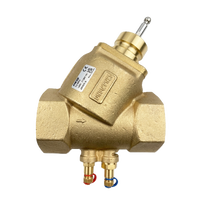
If you already know what a pressure-independent control valve does, the question that actually holds up a project is sizing: which valve size, which flow setting, and which actuator. Because PICVs regulate flow internally rather than relying on a calculated Kv against system pressure, the sizing process is different enough from conventional control valve sizing that applying old habits leads to under- or over-sized selections. This guide covers the sizing method step by step. For background on what a PICV is and how it works, see our PICV explainer article first.
Conventional control valve sizing calculates a required Kv (or Cv) from the design flow rate and the differential pressure available across the valve, then selects the nearest standard valve size and checks valve authority against the rest of the circuit. A PICV replaces that calculation with a direct flow-rate lookup: because the valve's internal pressure-independent mechanism regulates flow to a pre-set value across its entire rated differential pressure range, the design flow rate is matched directly against the manufacturer's flow-setting scale for each valve size, without needing to calculate Kv or check valve authority against the rest of the system.
This is a meaningful simplification for design and commissioning, but it also means the failure modes are different — sizing errors on a PICV show up as flow that's capped below design (valve too small for the required flow) or a flow setting sitting near the bottom of a valve's usable range (valve too large, reducing control resolution), rather than the valve authority and hunting problems associated with conventional undersized or oversized control valves.
Start from the terminal unit or coil's design flow rate in L/s or m³/h, taken from the mechanical services design (coil schedule, fan coil unit schedule, or AHU design data) — not from the pipe size or an assumed velocity. This figure is the single input that drives PICV selection, so confirm it against the actual design documentation rather than working backward from an installed pipe size.
Every PICV model publishes a flow-setting scale for each body size, showing the achievable flow rate range at each dial position (or, on digitally-set models, each percentage or numbered setting). Select the smallest valve size whose flow-setting range comfortably includes your design flow rate — ideally with the design flow falling in the middle third of the available range, which gives the best control resolution and leaves margin for commissioning adjustment.
| Indicative Valve Size | Typical Flow Range | Common Application |
|---|---|---|
| DN15 | ~0.02–0.3 L/s | Individual fan coil units, small terminal units |
| DN20–DN25 | ~0.1–0.9 L/s | Larger fan coil units, small AHU coils |
| DN32–DN40 | ~0.3–2.5 L/s | AHU heating/cooling coils, riser branch control |
| DN50 and above | ~1–6 L/s and up | Large AHU coils, main riser or plant room control |
These ranges are indicative only and vary meaningfully between manufacturers and even between model lines from the same manufacturer — always confirm against the specific product's published flow-setting chart rather than sizing from this table directly.
Every PICV has a minimum and maximum rated differential pressure across which its internal regulating mechanism functions correctly, commonly falling somewhere in the broad range of 15–400 kPa depending on model and size. Confirm the differential pressure actually available at the valve's installed location — not the pump's design head — sits within this rated range. On riser systems in particular, differential pressure at terminal units can vary significantly between the top and bottom floors, and a PICV sized correctly for flow can still under-deliver if installed below its minimum rated differential pressure.
PICV actuators are frequently specific to the valve manufacturer's mounting interface, stroke, and force rating, and are generally not interchangeable across brands even when the physical mounting appears similar. Confirm the actuator model recommended by the valve manufacturer for your specific valve size, and select on/off or modulating actuation based on the control strategy:
Need help sizing PICVs for your project?
Controls Traders supplies pressure-independent control valves and matched actuators for fan coil, AHU, and riser applications across Australia.
Contact Controls Traders — our technical team can confirm flow setting, differential pressure range, and actuator compatibility for your specific application.
Conventional control valve sizing starts with calculating a required Kv or Cv from the design flow rate and available differential pressure, then selecting the closest standard valve size and authority. PICV sizing instead starts directly from the design flow rate alone, because the valve's internal pressure-independent mechanism automatically regulates flow within its rated differential pressure range regardless of pressure variation elsewhere in the system. This means PICV selection is primarily a flow-rate lookup against the manufacturer's flow-setting scale for each valve size, rather than a Kv calculation — the valve size is chosen so the design flow rate falls within the usable range of the flow-setting dial, not simply matched to the pipe size it will be installed in.
No — this is the most common PICV sizing mistake. A PICV's flow capacity is set by its internal cartridge and flow-setting scale, not by its connection size, and manufacturers commonly offer the same body size across a range of flow-setting scales, or conversely a single flow requirement may be best served by a PICV one size smaller or larger than the pipe it connects to. Always size from the calculated design flow rate against the manufacturer's flow-setting chart for each valve size, then confirm the resulting connection size against the pipework — a reducing or increasing coupling either side of the valve is normal and not a sign of incorrect sizing.
Every PICV has a minimum and maximum differential pressure rating across which its pressure-independent mechanism functions correctly — commonly in the range of around 15 kPa to 400 kPa depending on the model and size, though the exact figures vary by manufacturer and valve size and must be checked against the specific datasheet. Below the minimum differential pressure, the valve cannot maintain its set flow rate and will deliver less than the design flow even fully open. Above the maximum rated differential pressure, the mechanism can be damaged or may fail to regulate accurately. Confirm the available differential pressure at the valve's installed location — not just the pump's design head — against the valve's rated range before finalising selection, particularly on risers where differential pressure varies significantly by floor.
Both are used depending on the control strategy. On/off (two-position) actuation is common on fan coil unit PICVs controlled by a simple room thermostat, where the valve is either fully open (delivering its pre-set design flow) or fully closed — the PICV's internal flow regulation means that even a two-position valve delivers a controlled, repeatable flow rate whenever open, which is a meaningful advantage over conventional 2-way valves in on/off applications. Modulating (0-10 V or floating point) actuation is used where the application needs proportional control of the delivered flow or leaving water temperature, such as AHU coil control or applications with a wide turndown requirement. Confirm the actuator's stroke and force or torque rating matches the specific PICV model — PICV actuators are frequently proprietary to the valve manufacturer and are not universally interchangeable across brands.
No — this is one of the main advantages of PICVs over conventional control valves paired with separate balancing valves. Because each PICV regulates its own flow to the pre-set value regardless of pressure variation elsewhere in the system, correctly sized and set PICVs eliminate the need for separate manual balancing valves at each terminal unit, which simplifies both the pipework and the commissioning process. This does not eliminate the need for correct system design — pump head still needs to be adequate to maintain minimum differential pressure at the most remote or highest-resistance PICV in the system — but it removes the iterative manual balancing process that conventional systems require across multiple terminal units on a shared pump.
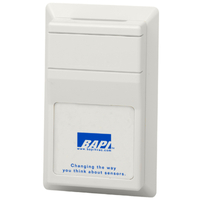
Building Automation Products Inc. (BAPI) manufactures a comprehensive range of sensors for HVAC and building automation applications. The BAPI sensor line covers CO₂, relative humidity, temperature, and combinations of all three parameters — in wall-mount, duct-mount, and outdoor configurations suitable for the full range of commercial and industrial building environments. The range is designed specifically for integration with Building Automation Systems (BAS), with output options to suit both analogue BMS inputs and digital field buses including BACnet MS/TP and Modbus RTU.
Controls Traders is an authorised Australian distributor of BAPI products, supplying the sensor range to mechanical contractors, building automation integrators, and consulting engineers across South Australia and nationally. This guide covers the BAPI sensor product categories, configuration options, output types, accuracy specifications, installation requirements, and selection guidance for common HVAC and BAS applications.
The BAPI range is structured around parameter combinations and mounting configurations, allowing engineers and BAS integrators to select the minimum sensor complexity needed for each application. The primary product categories are:
| Sensor Type | Parameters Measured | Available Mounting | Typical Application |
|---|---|---|---|
| CO₂ only | CO₂ concentration (ppm) | Wall, duct | Demand-controlled ventilation (DCV), CO₂ monitoring |
| CO₂ + temperature | CO₂ (ppm), temperature (°C) | Wall, duct | Zone control with DCV, replace two separate sensors |
| CO₂ + relative humidity | CO₂ (ppm), relative humidity (%RH) | Wall | IAQ monitoring where temperature is measured separately |
| CO₂ + RH + temperature | CO₂ (ppm), relative humidity (%RH), temperature (°C) | Wall | Full zone IAQ sensor — single device, all parameters |
| Humidity + temperature | Relative humidity (%RH), temperature (°C) | Wall, duct, outdoor | AHU humidity control, outdoor enthalpy measurement, zone monitoring |
| Temperature only | Temperature (°C) | Wall, duct, immersion, outdoor | Zone and duct temperature sensing, pipe immersion measurement |
Combination sensors deliver a meaningful installation efficiency advantage: where CO₂, humidity, and temperature are all needed in a single zone, one combination sensor requires one mounting location, one conduit entry, and — if using a digital output — a single pair of signal conductors carrying all three parameters to the BMS. This compares favourably with three separate sensors requiring three mounting locations, three conduit entries, and three sets of analogue wiring.
BAPI CO₂ sensors use Non-Dispersive Infrared (NDIR) sensing technology — the HVAC industry standard for CO₂ measurement. The NDIR cell passes infrared light through a sample chamber; CO₂ molecules absorb radiation at a characteristic wavelength of 4.26 μm. The ratio of the absorbed signal to a simultaneously measured reference signal (at a wavelength not absorbed by CO₂) is processed by the sensor electronics and converted to a CO₂ concentration reading in parts per million (ppm). A two-channel measurement approach compensates for gradual degradation of the infrared source over the sensor's service life, maintaining accuracy without requiring frequent external calibration.
BAPI CO₂ sensors incorporate automatic temperature compensation to maintain accuracy across the installation environment temperature range typical of wall-mount occupied space and duct applications. Without temperature compensation, the thermal expansion of gases in the NDIR sample chamber would introduce a systematic error as ambient temperature varies across the operating range — a particularly relevant consideration for duct sensors installed in AHU return sections where air temperature may vary seasonally.
Typical BAPI CO₂ sensor specifications:
ABC is effective for the majority of commercial building applications where the monitored space is regularly unoccupied. For continuously occupied environments — certain healthcare facilities, 24-hour operations centres, or manufacturing spaces — manual calibration against 400 ppm reference gas should be scheduled on an annual basis. Record calibration dates and readings in the asset management system or BMS historian.
BAPI humidity sensors use a capacitive polymer sensing element — the industry-standard technology for HVAC-grade humidity measurement. A thin polymer film changes its dielectric constant in proportion to the relative humidity of the surrounding air; the resulting change in capacitance is measured electronically and converted to a percentage relative humidity (%RH) reading. Capacitive polymer sensors are well-suited to commercial HVAC applications: they respond reasonably quickly to humidity changes, recover well from brief condensation events (assuming the condensation clears), and maintain accuracy across the 0–95% RH range encountered in occupied building environments.
Typical specifications for BAPI capacitive humidity sensors:
An important application note for BAPI humidity sensors — and capacitive polymer sensors generally: these sensors are susceptible to contamination from high concentrations of volatile organic compounds (VOCs). Prolonged exposure to elevated VOC concentrations can cause the polymer film to absorb contaminants, leading to a permanent offset error in the humidity reading that cannot be corrected by recalibration. For most commercial HVAC applications — offices, retail, educational facilities, healthcare — this is not a concern. In spaces with regular solvent-based cleaning operations, paint spray booths, laboratories with organic solvent use, or industrial processes generating high VOC loads, confirm sensor suitability with the specifying engineer before installation. In those environments, BAPI or the Controls Traders technical team can advise on appropriate sensor selection or placement strategies to minimise exposure.
BAPI temperature sensors are available with thermistor (NTC) or platinum RTD (PT100, PT1000) sensing elements, with the choice depending on the application accuracy requirements, cable run length, and BMS input type.
Thermistor (NTC) elements — typically 10 kΩ NTC — are the most common choice for wall-mount room temperature sensors in commercial BAS applications. The 10k NTC characteristic is supported natively by virtually all BMS platforms as a standard universal input type, and the passive thermistor output requires no sensor power supply (the BMS provides a small excitation current). NTC thermistors provide good sensitivity across the typical occupied space temperature range of 15–35°C, with accuracy generally better than ±0.5°C when the BMS input is correctly characterised to the thermistor curve. For longer cable runs — typically above 30–50 m — the cable resistance relative to the thermistor impedance becomes a source of measurement error; in these cases, an active 4-20 mA or 0-10 V output is preferred.
Platinum RTD elements (PT100 or PT1000) offer higher accuracy and better linearity across a wider temperature range than NTC thermistors, and are typically specified for duct and immersion sensors where temperatures may extend below 0°C or above 60°C, or where measurement accuracy better than ±0.5°C is required. PT1000 elements are generally preferred over PT100 for HVAC applications because the higher base resistance (1,000 Ω vs 100 Ω at 0°C) reduces the relative contribution of cable resistance to measurement uncertainty.
Active temperature sensor outputs (4-20 mA or 0-10 V, requiring 24 VAC/DC supply) are available on BAPI combination sensors, and are recommended for cable runs exceeding approximately 50 m, or where the sensor is installed in high-electrical-noise environments such as plant rooms with variable-speed drives.
BAPI sensors are available with a range of output options to match the input types and field bus architecture of the building automation system. Selecting the correct output at the time of order is important — most BAPI sensors are configured at the factory for a specific output type, and field conversion between output types is not generally supported.
| Output Type | Signal | Typical Use Case |
|---|---|---|
| Analogue voltage | 0–5 V or 0–10 V | BMS analogue input, cable runs under 30 m in low-noise environments |
| Analogue current | 4-20 mA | BMS analogue input, longer cable runs, electrically noisy plant rooms |
| BACnet MS/TP | Digital RS-485 | Direct BMS field bus integration; multiple parameters on single two-wire bus |
| Modbus RTU | Digital RS-485 | Modbus-compatible controllers, data loggers, energy metering systems |
| Passive thermistor | 10k NTC resistance | Temperature-only sensing via BMS universal input (no power supply required) |
For combination sensors measuring CO₂, humidity, and temperature in a single housing, BACnet MS/TP or Modbus RTU outputs are strongly recommended over analogue. With analogue outputs, each parameter requires a dedicated pair of conductors, a dedicated BMS analogue input channel, and individual scaling and engineering unit configuration. With a digital output, all three parameters are transmitted over a single screened twisted-pair bus, with each parameter appearing as a separate object or register in the protocol. This can reduce field wiring by 60–70% in multi-sensor installations and simplifies BMS commissioning. For guidance on selecting between BACnet MS/TP and Modbus RTU for your specific BMS architecture, see our article on BACnet vs Modbus (link to be added when article is published).
BAPI wall-mount sensors are designed to mount on a standard electrical backbox. The sensor uses a two-part assembly: a base plate that fixes to the backbox and accepts the field wiring via a removable terminal block, and a sensor head that clips onto the base. This design has a practical maintenance advantage — the sensor head can be removed for servicing, replacement, or temporary relocation without disturbing the field wiring, which remains connected to the base terminal block.
Correct placement is critical to the accuracy of wall-mount zone sensors. The following guidelines apply across all parameter types:
BAPI duct sensors mount through a circular penetration (typically 32 mm diameter) in the duct wall, secured with a flanged housing and self-tapping screws into the duct sheet metal. The sensing probe extends into the duct airstream. Access for installation and maintenance requires a clear working space adjacent to the duct penetration — confirm that the selected mounting location is accessible after the duct is insulated, and that any insulation jacket can be locally removed and reinstated without damaging the sensor wiring.
Application-specific mounting location guidance:
Verify duct air velocity at the installation point against the sensor's rated maximum. Most BAPI duct sensors are rated for airstream velocities up to 10–15 m/s. At velocities above this, mechanical fatigue of the probe and errors from velocity pressure effects on the sensing element may reduce long-term reliability and accuracy. At very low velocities (below 0.5 m/s), response time may be extended due to limited convective airflow past the sensing element.
The following selection logic covers the most common HVAC and BAS applications for BAPI sensors. Confirm output type compatibility with the BMS analogue input or field bus architecture before placing an order — this is the most common source of ordering errors and cannot be corrected in the field without sensor replacement.
For applications not covered by the above, or where there is uncertainty about the correct BAPI product for a specific BMS input type or protocol configuration, contact Controls Traders for technical selection support. The Controls Traders team can advise on current BAPI product availability, lead times for non-stock configurations, and compatibility with major BMS platforms installed in the Australian market.
A combination sensor in a single housing reduces installation time and wiring cost, and avoids the problem of parameters being measured at different locations in the zone — which can introduce inconsistencies in data interpretation. Where CO₂, humidity, and temperature all need to be monitored in a given zone, a combination sensor is typically the better choice for both cost and data quality reasons. Use separate sensors only when different parameters genuinely need to be measured at different locations — for example, a duct humidity sensor at the AHU to control supply humidity, combined with a wall CO₂ sensor in the occupied zone for DCV. A combination sensor in that scenario would measure supply duct conditions for humidity and zone conditions for CO₂, which are incompatible measurement requirements.
For individual zone control in a VAV system, wall-mount CO₂ sensors in each zone with 0-10 V or 4-20 mA output to the local VAV controller are the standard approach — the zone controller reads CO₂ and adjusts the VAV damper position directly. Where the BMS is managing DCV centrally rather than at the zone controller level, BACnet MS/TP sensors reduce analogue input count significantly: each sensor appears as a BACnet device on the RS-485 field bus, and the BMS reads CO₂ (and temperature and humidity if present) as standard BACnet Analogue Input objects. Contact Controls Traders for advice on the best BAPI model for your specific zone controller type and BMS platform.
For analogue voltage output sensors (0-10 V), three conductors are needed: 24 VAC/DC power supply positive, signal output (wired to BMS analogue input channel), and power/signal common. For 4-20 mA two-wire loop-powered sensors, only two conductors are needed — the supply and the return, which carries the current signal; the BMS analogue input provides the loop supply voltage. For BACnet MS/TP or Modbus RTU sensors, use a screened twisted-pair cable for the RS-485 bus, connecting data (+), data (−), and cable screen to the sensor terminal block. Observe bus termination requirements: terminate the RS-485 bus at both physical ends with the specified termination resistor value (typically 120 Ω), and ensure all devices on the bus share a common reference (signal ground). Confirm addressing requirements — BACnet MS/TP devices require unique MAC addresses in the range 1–127 for field devices, while Modbus RTU devices require unique slave addresses in the range 1–247.
BAPI capacitive polymer humidity sensors are typically rated at ±3% RH accuracy at 25°C across the 10–90% RH range. At the extremes of the measurement range — below 10% RH or above 90% RH — accuracy may be slightly reduced, though these extremes are rarely encountered in normal commercial HVAC operation. In practice, HVAC humidity control setpoints are typically 40–60% RH for comfort control and 30–65% RH for IAQ compliance, well within the range where ±3% RH accuracy is fully maintained. For critical process applications requiring tighter humidity accuracy — pharmaceutical cleanrooms, certain laboratory environments — confirm with Controls Traders whether a higher-accuracy sensor grade is appropriate.
Yes. BAPI offers BACnet MS/TP (RS-485 physical layer) as an output option across their range of combination and standalone CO₂, humidity, and temperature sensors. BACnet MS/TP sensors connect to the BMS's RS-485 field bus alongside other BACnet field devices, with each sensor appearing as a BACnet device presenting Analogue Input objects for each measured parameter — CO₂ concentration, relative humidity, and temperature as applicable. BAPI also offers Modbus RTU output as an alternative for systems using Modbus-based controllers, sub-meters, or data loggers where BACnet is not available or where the system integrator prefers Modbus. Confirm the required protocol and output configuration with Controls Traders before ordering, as factory configuration is required for digital output variants.