










Belimo Model Numbers Explained: A Practical Guide for HVAC Engineers and Contractors
If you've ever stared at a Belimo part number like NMB24-MFT-T or R2025-B2 and wondered what each segment means, you're not alone. Belimo model numbers follow a precise alphanumeric logic — once you understand the system, you can read any Belimo code off a datasheet and know immediately what you're looking at: torque, fail-safe type, voltage, control signal, valve size.
This guide decodes the system end to end, covering damper actuators, control valves, and the most commonly specified variants used in Australian commercial HVAC and building automation projects.
Controls Traders stocks the full Belimo product range as an authorised Australian distributor. If you need to cross-reference a model or check availability, the Belimo brand page is the place to start.
The Belimo Naming Architecture — A Quick Overview
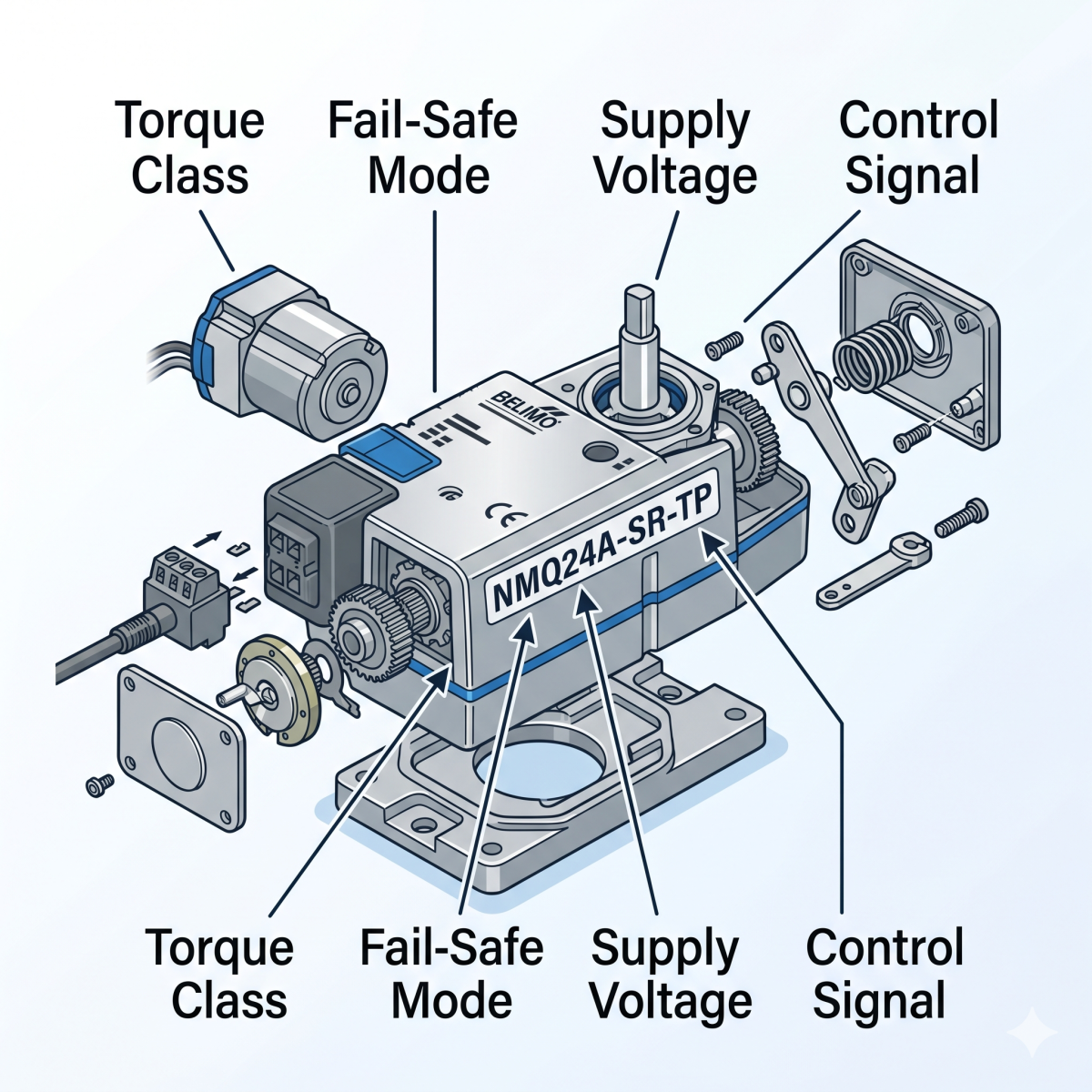
Belimo model numbers are not random. They encode, from left to right:
- Torque class (for actuators) or valve configuration (for valves)
- Fail-safe mode — spring return, non-spring return, or electronic fail-safe
- Configuration type — basic, flexible, or rotary valve mount
- Supply voltage
- Control signal type — indicated by the suffix after the dash
- Optional features — auxiliary switches, terminal blocks, communication protocols
Some positions are letters, some are numbers, and the suffixes add further layers. Work through each position in sequence and the code becomes readable in under a minute.
Damper Actuator Model Numbers Decoded
Position 1: Torque Class
The first letter of any Belimo damper actuator indicates how much torque it produces. This is the most critical spec — undersize the actuator and the damper won't close properly; oversize and you've wasted money and potentially damaged the damper linkage.
| First Letter | Torque | Typical Application |
|---|---|---|
| T | 2 Nm | Small zone dampers, VAV boxes |
| L | 5 Nm | Small to medium dampers |
| N | 10 Nm | Medium commercial dampers |
| A | 20 Nm | Large AHU dampers |
| G | 40 Nm | Very large dampers, multi-stack assemblies |
| E | Variable | Large or specialty applications |
As a rule of thumb, calculate 1 Nm per 1.5–2 m² of damper area, then select the next torque class up for safety margin. Tight-sealing dampers, cold climates, and ageing linkages all increase the effective torque requirement.
Position 2: Fail-Safe Mode
The second letter defines how the actuator behaves on power loss — critical for life safety applications and sequence-of-operations design.
- F — Spring return (fail-safe). An internal mechanical spring drives the actuator to a defined fail position (fully open or fully closed) when power is removed. Required for outdoor air intakes, fire mode interlocks, and any application where a defined fail position is mandatory.
- M — Non-spring return (modulating). The actuator holds its last commanded position on power loss. Standard for heating and cooling coil valves where position memory is acceptable and no life-safety requirement applies.
- K — Electronic fail-safe. Uses an onboard capacitor to drive the actuator to the fail position rather than a mechanical spring. Quieter and lighter than spring-return, but requires the capacitor to be charged.
This is why LF and LM are different products despite looking similar at first glance. An LF will spring-return on power loss; an LM will hold position.
Position 3: Configuration Type
- B — Basic or standard configuration
- X — Flexible or configurable (used with MFT units that can be field-programmed)
- R — Rotary valve mount (factory-installed linkage for direct coupling to valve bodies)
Voltage — The Middle Numbers
The digits following the configuration letter indicate supply voltage:
- 24 — 24 V AC/DC (most common in BAS panel applications)
- 120 — 120 V AC
- 230 — 230 V AC (common in Australian commercial installations)
- UP — Universal power supply (AC 24–240 V / DC 24–125 V) — the most flexible option, especially useful in retrofit projects where supply voltage at the panel is unknown
A full actuator code up to this point looks like: NMB24 — a 10 Nm, non-spring return, basic actuator running on 24 V.
Control Signal Suffixes
The suffix after the dash defines how the actuator receives its control signal:
- -3 — Floating (three-point) control. Separate open and close pulse signals drive the actuator motor. Simple, reliable, and requires no feedback signal. Suitable for two-position and coarse modulating applications.
- -SR — Proportional control via a 2–10 V DC input. Important: the "SR" does not stand for spring return — it refers to the signal range. This is one of the most common misreadings among engineers new to Belimo.
- -MFT — Multi-Function Technology. Field-programmable actuator configured via Belimo's PC-Tool software for floating, proportional (0–10 V), or other control modes. Supports BACnet MS/TP and Modbus RTU communication via a Belimo ZipLink or bus module. The preferred specification for intelligent BAS integrations.
Option Suffixes
- -S — One or more built-in auxiliary switches. Required when your sequence of operations needs a damper-open proof signal for fan interlock, or a BAS feedback input.
- -T — Terminal block wiring rather than a pre-attached cable. Useful where the actuator is field-wired directly into a BAS panel.
Putting It Together — A Full Example
NMB24-MFT-T
- N = 10 Nm torque
- M = Non-spring return (holds position on power loss)
- B = Basic configuration
- 24 = 24 V AC/DC supply
- MFT = Multi-Function Technology, field-programmable, BACnet/Modbus capable
- T = Terminal block wiring
If you're specifying damper actuators for AHUs or VAV systems, the MFT suffix gives you maximum flexibility for future reprogramming without changing hardware — a smart investment on any project that will run a modern BAS.
Fire and Smoke Actuator Model Numbers
Fire and smoke actuators follow the same base logic but are prefixed with FS to denote compliance with fire-rated damper requirements:
- FSLF — Fire/smoke, low torque (approximately 30 in-lb)
- FSNF — Fire/smoke, medium torque
- FSAF — Fire/smoke, high torque (approximately 180 in-lb)
These actuators are independently tested and certified for operation at elevated temperatures (up to 177°C / 350°F). Never substitute a standard damper actuator on a fire/smoke damper regardless of torque match — the independent certification is what matters, and the installation will not meet NCC or AS 1668 requirements without it.
Control Valve Model Numbers Decoded
Belimo valve model numbers encode valve type, pipe size, and — for pre-assembled units — the actuator pairing. The logic is separate from the actuator naming but equally systematic.
R-Series: Characterised Control Valves
The R2.. and R3.. series are characterised control valves for modulating control of chilled water, hot water, and condenser water circuits.
- R2 — 2-way characterised control valve
- R3 — 3-way characterised control valve
The digits following indicate DN (nominal bore) size:
| Model Code | DN Size | Common Application |
|---|---|---|
| R2015 | DN 15 (½") | Fan coil units, small terminal units |
| R2020 | DN 20 (¾") | Larger FCUs, small AHUs |
| R2025 | DN 25 (1") | AHU coils, medium capacity systems |
| R2032 | DN 32 (1¼") | Medium-large coils |
| R2040 | DN 40 (1½") | Large AHU coils |
| R2050 | DN 50 (2") | Large capacity coils, chiller connections |
Important: Valve sizing is based on Kv/Cv flow coefficient and system flow rate — not on pipe connection diameter alone. Oversizing a valve (selecting a larger Kv than required) causes the valve to run at very low percentage open, destroying control authority and making the system difficult to commission. Use Belimo's selection tool or the Kv calculation method at the design stage.
For fan coil unit and terminal unit control applications, the R2015 and R2020 characterised valves paired with a rotary actuator are the most common specification in Australian hotel and commercial projects.
B-Series: Pre-Assembled Ball Valve Units
The B2.. and B3.. series are factory-assembled valve and actuator combinations:
- B2 — 2-way ball valve assembly
- B3 — 3-way ball valve assembly
These arrive from the factory with a matched Belimo actuator already installed, which reduces installation time and the risk of mismatched torque selection. The actuator designation follows the valve body code and determines control type, voltage, and fail-safe behaviour.
If you're comparing control valve options for chilled or hot water systems, the B-series simplifies procurement and installation but offers less field-configuration flexibility than a separately mounted R-series valve with a chosen actuator.
Pressure-Independent Control Valves
Belimo's pressure-independent valve range uses distinct model designations:
- PICCV — Pressure independent characterised control valve. Integrates a differential pressure regulator, removing the need for separate manual balancing valves. Pre-set from the factory to the design flow.
- EPIV — Electronic pressure independent valve. Adds flow measurement capability via onboard electronics.
- Energy Valve (EV..) — Combines PICV function, energy metering, and BACnet/Modbus communication in a single device. Provides real-time coil delta-T monitoring and can detect fouled coils. Increasingly specified on large chilled and hot water distribution systems.
These products are specified at design stage and selected by maximum design flow (L/s or GPM), not by Kv. No manual commissioning of flow balancing is required after installation.
Common Ordering Mistakes to Avoid
1. Confusing -SR with spring return. The -SR suffix on a Belimo actuator means 2–10 V DC proportional signal, not spring return. For spring return, look at the second character — 'F' for spring return. An NM24-SR is a non-spring-return actuator with proportional control; an NF24-SR is spring return with proportional control.
2. Incorrect voltage specification. Ordering a 24 V actuator into a 230 V panel causes equipment damage and a field rework. Australian commercial installations commonly use 230 V panels — verify the panel supply voltage before specifying.
3. Torque undersizing. Default to the next torque class up from your calculated requirement. Tight-sealing dampers, cold climates, and ageing linkage hardware all increase effective torque demand beyond the theoretical calculation.
4. Sizing a valve by connection diameter rather than Kv. The pipe size printed on a valve does not determine whether it's right for your application. An oversized valve running at 5% open has very poor control authority. Calculate Kv from design flow and acceptable pressure drop.
5. Forgetting auxiliary switch requirements. If your sequence of operations requires a damper-open proof signal to enable a fan start, the base actuator will not provide it. Order the -S variant at design stage — retrofitting auxiliary switches in the field is difficult and usually requires a unit swap.
Frequently Asked Questions
What does the 'F' mean in Belimo model numbers like LF24 or NF24?
The 'F' in the second position indicates spring return (fail-safe) operation. When power is removed, an internal spring drives the actuator to its fail position — either fully open or fully closed depending on how the actuator is mounted and wired. This behaviour is distinct from 'M' (non-spring return — holds last position on power loss) and 'K' (electronic fail-safe — capacitor-driven return to fail position).
What is the difference between Belimo -3 and -SR control signal types?
The -3 suffix indicates floating (three-point) control: separate open and close pulse signals drive the actuator motor in each direction. The -SR suffix indicates proportional control via a 2–10 V DC input that positions the actuator continuously across its full stroke. Proportional control provides finer modulation and is preferred for chilled water and heating coil valve applications. Floating control is simpler, lower cost, and entirely adequate for on/off and two-position damper applications.
What does MFT mean on a Belimo actuator, and does it support BACnet?
MFT stands for Multi-Function Technology. MFT actuators are field-programmable via Belimo's PC-Tool software — control direction, signal range, fail position, and operating time can all be configured on site without hardware changes. When used with a Belimo ZipLink module or bus interface, MFT actuators support BACnet MS/TP and Modbus RTU communication, enabling full integration into a building automation system.
How do I size a Belimo R-series characterised control valve?
Size the valve by Kv (flow coefficient) value, not by pipe connection diameter. Calculate the required Kv from your coil design flow rate (L/s) and the acceptable pressure drop across the valve (typically 25–50% of the coil pressure drop for good control authority). Use Belimo's online selector tool or the formula Kv = Q / √ΔP to arrive at the correct model number. Always aim for a valve authority of 0.5 or above at design conditions.
Can a Belimo actuator be replaced without replacing the valve body?
Yes, for separately specified R-series valve and actuator combinations. Belimo actuators use a direct-coupled shaft interface that allows the actuator to be removed and replaced without disturbing the valve body or pipework. The replacement actuator must have equal or greater torque than the original and a compatible shaft interface. For B-series pre-assembled ball valve units, the valve and actuator are typically replaced as a complete unit since the assembly is factory-set.
Summary
Belimo model numbers are systematic, not arbitrary. Reading from left to right: torque class, fail-safe mode, configuration type, voltage, then control signal and options as suffixes. For valves, the series prefix tells you valve type and configuration, and the following digits give DN size or flow class.
Understanding the code means specifying correctly the first time, identifying cross-references quickly, and verifying that what arrives on site matches the design intent — a small investment that pays off every time a delivery note lands on the workbench.
Controls Traders is an authorised Belimo distributor in Australia. Browse the full Belimo product range or contact the team for selection support on your next project.
Leave a comment
Popular Posts
A Practical Guide to Actuator Selection for HVAC Applications
Spring-Return vs Non-Spring-Return Actuators: Which Do You Need?
PICV Sizing and Selection Guide for HVAC Systems