










Fan Coil Unit Room Controllers: How to Choose the Right Thermostat for Hotel and Commercial FCUs
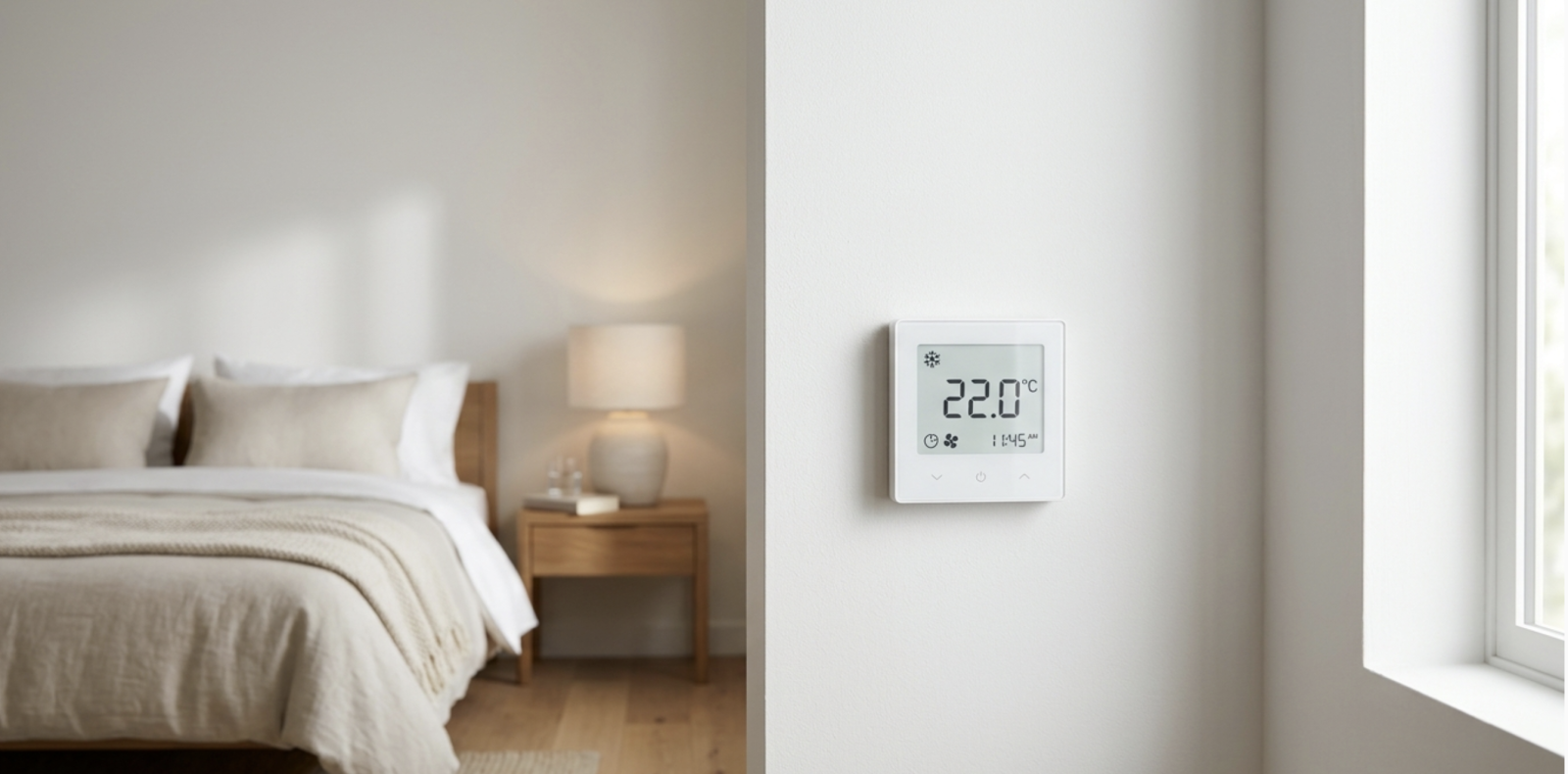
Fan coil unit (FCU) room controllers are the most common interface between building occupants and HVAC systems in hotels, apartments, offices and healthcare facilities across Australia. Choose the wrong one and you will spend months dealing with occupant complaints, energy waste and callbacks. Choose the right one and the system runs quietly in the background for a decade.
This guide covers the key decisions engineers, electrical contractors and facility managers need to make when specifying an FCU room controller — from system type and control signal through to brand selection and BMS integration.
What Is an FCU Room Controller?
An FCU room controller is a standalone thermostat or controller that manages the fan speed and valve position of a fan coil unit to maintain a set temperature in a room or zone. It reads the room temperature, compares it to the occupant setpoint, and signals the FCU fan and control valve to heat or cool as required.
Unlike full BMS controllers — which require programming, commissioning and network configuration — FCU room controllers are pre-configured for specific applications and designed for direct installation by electricians without specialist BMS expertise. That makes them the preferred choice for projects where room-level control needs to be straightforward and reliable.
2-Pipe vs 4-Pipe FCU Systems
Before specifying a room controller, you need to know whether the FCU system is 2-pipe or 4-pipe, as this determines which controller outputs you need.
- 2-pipe systems: One supply and one return pipe. The system runs either heating or cooling depending on the season, and the room controller manages a single 2-way or 3-way control valve. Common in older Australian commercial buildings and budget hotels.
- 4-pipe systems: Separate heating and cooling circuits. The room controller must manage two control valves — one for the cooling coil and one for the heating coil — plus the fan. This gives simultaneous heating and cooling capability and is standard in premium hotels and modern office buildings.
Some controllers handle both configurations, but check the output count and relay specifications carefully before assuming a single model will cover both applications.
Key Selection Criteria
1. Supply Voltage
Most FCU room controllers for commercial and hotel applications in Australia run at 230V AC, matching standard building wiring. Some 24V AC models exist — common in older Schneider/TAC installations — but the majority of new Australian projects use 230V controllers. Always confirm the electrical circuit design before selecting a controller.
2. Fan Speed Outputs
Standard FCUs run 2-speed or 3-speed fans. Your controller needs the matching number of relay outputs. A 3-speed controller on a 2-speed FCU is fine — you simply do not wire the third speed. The reverse is not workable without modifications.
3. Valve Output Type
This is where most specification errors occur. The three common output types are:
- On/Off (2-position): Opens or closes the valve fully. Simple and cost-effective, but causes temperature hunting in precise comfort applications. Suitable for low-demand zones or budget installations.
- 3-position (floating): Opens, closes, or holds the valve in position — more stable than on/off without requiring a modulating actuator. A good middle-ground for most commercial FCU applications.
- Modulating (0–10V or 4–20mA): Proportional control that positions the valve at any point between 0 and 100%. Best for tight temperature control and energy efficiency. Requires a compatible modulating valve actuator.
The controller output type and the actuator type must match. A modulating controller wired to an on/off actuator will still only open or close fully, regardless of the signal being sent.
4. Hotel vs Commercial Office Requirements
Hotel applications have specific requirements that standard commercial controllers do not always address:
- Lockable setpoint range — guests can adjust temperature within a band defined by management, typically ±2°C from a central setpoint
- Card-key input — the controller switches to an energy-saving setback mode when the guest key card is removed from the room
- Window contact input — the system reduces output or shuts off when a window or balcony door is open
- Guest-facing display — shows temperature in Celsius with no engineering or configuration menus accessible to guests
Purpose-built hotel room controllers like the Siemens RDF300 and RDG series address all of these out of the box. Using a standard commercial thermostat in a hotel without configuring the setpoint lock leads to guests pushing temperatures to extremes, defeating the building's energy management strategy and increasing operating costs.
5. BMS Integration
For projects that require room-level data in a building management system, consider controllers with BACnet or Modbus communication. These allow the BMS to read live room temperature, override setpoints centrally, and log occupancy and fault data.
Not every project needs this. Standalone controllers are the right choice when rooms operate independently. For hotels with property management system integration, or commercial buildings with centralised energy monitoring, communicating controllers justify the additional cost through operational savings.
FCU Room Controllers at Controls Traders
Controls Traders is an authorised distributor for Siemens, Schneider Electric, Smart Temp and Hevac. Our range covers the full spectrum from basic on/off hotel thermostats to fully communicating BACnet zone controllers, with stock held in Adelaide for fast Australia-wide delivery.
Siemens RDF and RDG Series
The Siemens RDF300 is our most popular FCU room controller. It runs at 230V AC, offers on/off or 3-position output, has an LCD display with occupant temperature adjustment, and includes multifunctional inputs for window contact, heat/cool changeover and external temperature sensor. It is flush-mounted to a standard rectangular conduit box (BS4662, 60.3mm fixing centres) — compatible with standard Australian electrical back boxes.
The RDF series suits 2-pipe and simple 4-pipe applications where proportional control is not required. For more complex hotel installations — where card-key switching, presence detection or wider programmability is needed — the Siemens RDG160T, RDG200T and RDG400 offer expanded I/O and configuration options.
Schneider SpaceLogic T900 and SE8000 Series
The Schneider SE8000 series and SpaceLogic T900 range are the right choice when BMS integration is required. These controllers communicate over BACnet MS/TP, support 4-pipe FCU configurations, and have configurable outputs for fan coil applications. They are commonly specified in commercial office buildings and larger hotel projects where room-level monitoring feeds into a central BMS or SCADA system.
Smart Temp
Smart Temp manufactures FCU room controllers and thermostats designed specifically for the Australian and New Zealand market. Their range is well-suited to education and healthcare facilities and is a popular choice with building services contractors who prefer locally-supported products.
Hevac
Hevac controllers cover single-stage and multi-stage heating and cooling control, suitable for simpler FCU and hydronic heating applications. The HTC-2 and HTC-4 are common in commercial and light industrial settings where a straightforward, reliable temperature controller is needed without network connectivity.
Quick Comparison
| Brand / Series | Application | System Type | Voltage | Key Feature |
|---|---|---|---|---|
| Siemens RDF300 | Hotel guest rooms, commercial FCU | 2-pipe & 4-pipe | 230V AC | Guest setpoint lock, card-key input, LCD display |
| Siemens RDG160T / RDG400 | Premium hotel, complex FCU | 2-pipe & 4-pipe | 230V AC | Extended I/O, programmable, window contact |
| Schneider SE8000 | Commercial offices, BMS projects | 4-pipe | 24V AC | BACnet MS/TP, configurable outputs |
| Schneider SpaceLogic T900 | Commercial & hotel BMS integration | 2-pipe & 4-pipe | 24V AC | BACnet, NFC commissioning |
| Smart Temp | Education, healthcare, commercial | 2-pipe | 230V AC | Australian designed, local support |
| Hevac HTC-2 / HTC-4 | Commercial, light industrial | 2-pipe heating | 230V AC | Simple, reliable, no BMS required |
Common Specification Mistakes
These are the most frequent issues we see at Controls Traders when projects are commissioning:
- Mismatched actuator and controller output: Specifying a modulating (0–10V) controller without confirming the valve actuator is also modulating. If the actuator is on/off, the valve will only open or close fully regardless of the control signal.
- No setpoint lock in hotel rooms: Installing a standard commercial thermostat in a hotel room without configuring the setpoint lock. Guests will always adjust temperatures to extremes, increasing energy costs and HVAC wear.
- Wrong conduit box standard: Not all European FCU controllers fit standard Australian rectangular back boxes without an adapter plate. Check mounting dimensions (standard Australian fixing is 60.3mm centres) before specifying.
- Voltage mismatch: Installing a 24V AC controller on a 230V AC circuit. Always confirm the electrical design before selecting a controller. If 24V is required and the existing circuit is 230V, a step-down transformer is needed.
- Selecting a 2-pipe controller for a 4-pipe system: A 2-pipe controller has one valve output and cannot independently manage separate heating and cooling valves. This results in either simultaneous heating and cooling or loss of one function entirely.
Controls Traders stocks the complete Siemens RDF and RDG series, Schneider SpaceLogic T900 and SE8000, Smart Temp and Hevac FCU room controller ranges. As an authorised distributor for all brands, we carry genuine products with full manufacturer support, stocked in Adelaide for Australia-wide delivery.
Browse our stand-alone controllers and thermostats range online, or call our technical team on 1300 740 140 for application-specific advice.
Frequently Asked Questions
What is the difference between an FCU room controller and a standard thermostat?
An FCU room controller is specifically designed to manage both the fan speeds and the control valve of a fan coil unit. A standard thermostat typically only switches heating or cooling on or off. FCU controllers have multiple relay outputs for fan speed stages and separate valve outputs for heating and cooling, making them purpose-built for fan coil applications in commercial and hotel buildings.
Can I use a 2-pipe FCU controller on a 4-pipe system?
No. A 2-pipe controller only has one valve output and cannot independently control the heating and cooling valves required in a 4-pipe system. Using the wrong controller will result in either simultaneous heating and cooling, or a complete loss of one function. Always confirm whether the system is 2-pipe or 4-pipe before specifying a controller.
What is the best FCU room controller for hotel guest rooms in Australia?
For most Australian hotel applications, the Siemens RDF300 or RDG series offers the right balance of features, reliability, and ease of installation. Key hotel-specific requirements include a lockable setpoint range, card-key input for occupancy switching, and a guest-friendly display without accessible engineering menus. Siemens' RDF and RDG controllers support all of these natively and are stocked by Controls Traders in Adelaide.
Does an FCU room controller need to connect to a BMS?
Not necessarily. Many FCU room controllers operate as standalone devices with no network connection, which is sufficient for smaller buildings or projects where room-level data is not required centrally. For hotels with property management system integration, or commercial buildings with centralised energy monitoring, BACnet-communicating controllers like the Schneider SE8000 or SpaceLogic T900 allow the BMS to read temperature, override setpoints, and log occupancy and fault data.
What supply voltage do FCU room controllers use in Australia?
The majority of FCU room controllers in Australian commercial and hotel applications run at 230V AC, which is the standard Australian building supply voltage. Some older systems and European product ranges use 24V AC, which requires a step-down transformer. Always confirm the supply voltage from the electrical drawings before selecting a controller.
What is the difference between on/off, 3-position and modulating valve outputs on an FCU controller?
On/off control opens or closes the valve completely, which is simple but causes temperature fluctuations. 3-position (floating) control can open, close, or hold the valve in position, giving more stable control without needing a modulating actuator. Modulating (0-10V) control positions the valve proportionally between 0 and 100%, providing the most precise temperature control but requiring a compatible modulating actuator on the valve body.
How do I know if my FCU system is 2-pipe or 4-pipe?
Count the pipes connected to the fan coil unit. A 2-pipe system has one supply pipe and one return pipe — the same circuit provides either heating or cooling depending on the season. A 4-pipe system has two supply pipes and two return pipes — one circuit for chilled water (cooling) and a separate circuit for hot water (heating). If you are unsure, check the mechanical services drawings or the FCU manufacturer's documentation.
Leave a comment
Popular Posts
A Practical Guide to Actuator Selection for HVAC Applications
Spring-Return vs Non-Spring-Return Actuators: Which Do You Need?
PICV Sizing and Selection Guide for HVAC Systems