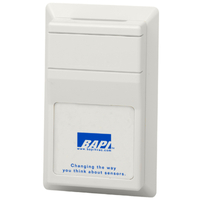











Maximizing Accuracy with DP Sensors and Air Gauge Accessory Kits
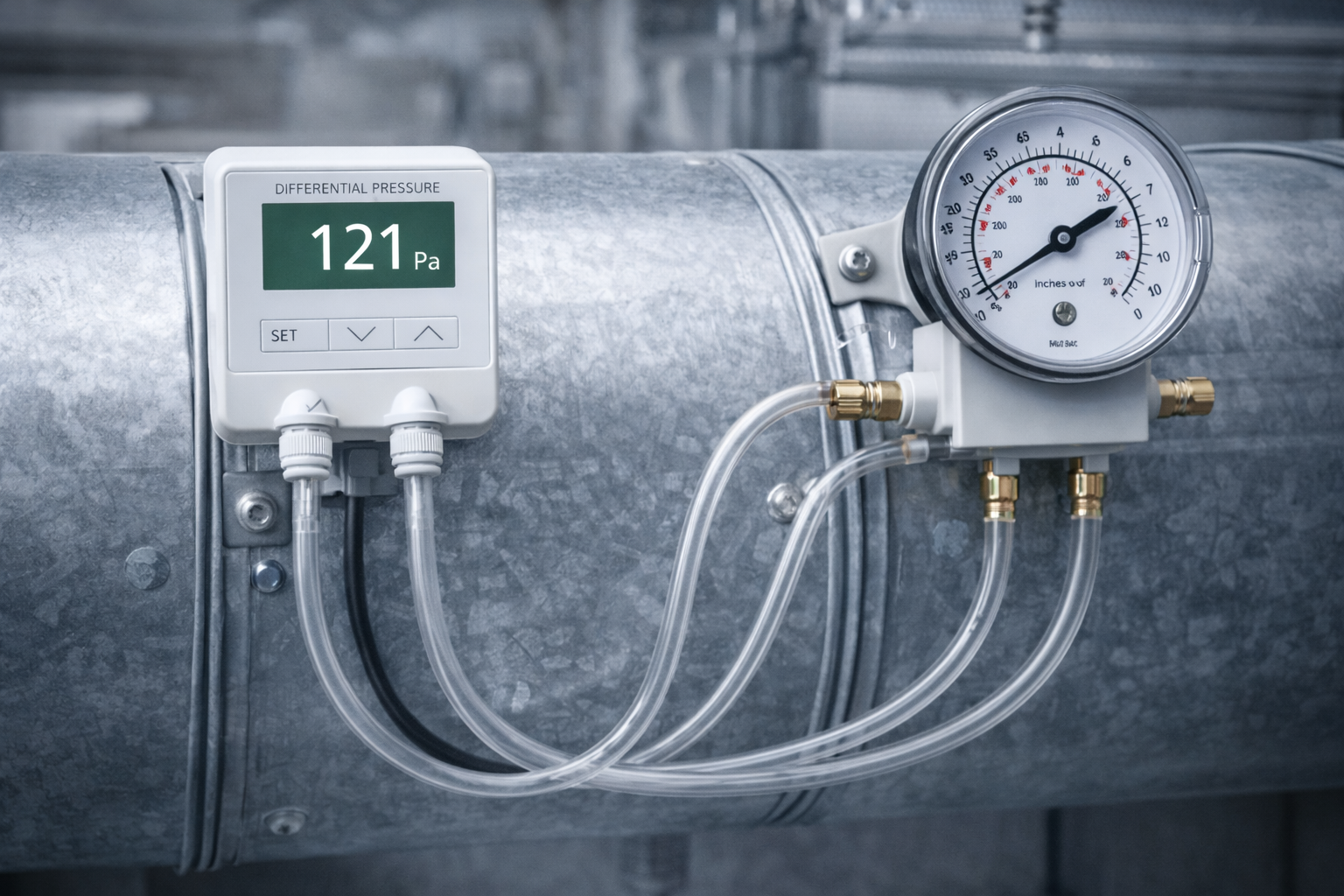
Maximizing Accuracy with DP Sensors and Air Gauge Accessory Kits
In the realm of building automation, while temperature sensors dictate comfort, pressure sensors dictate safety and mechanical efficiency.
Differential Pressure (DP) sensors are the silent workhorses of the plant room. They allow the Building Management System (BMS) to "feel" the resistance in the ductwork, providing the critical data needed to ramp up Variable Speed Drives (VSDs) or trigger maintenance alarms.
At Controls Traders, we stock high-accuracy air pressure sensors from brands like BAPI and Schneider Electric, alongside the necessary hardware to install them. Here is a guide on maximizing your airside accuracy.
Why Monitor Differential Pressure?
An air DP sensor measures the difference in pressure between two distinct points and outputs an electrical signal (like 0-10V) to the BMS. There are two primary applications in HVAC:
1. Filter Monitoring: As Air Handling Unit (AHU) filters accumulate dust, the pressure drops significantly across the filter bank. By placing the "High" port of the sensor before the filter and the "Low" port after the filter, the BMS can monitor this resistance. Once it hits a critical threshold (e.g., 150 Pascals), the system flags a "Dirty Filter" alarm, ensuring maintenance is driven by actual data rather than a calendar.
2. Duct Static Pressure Control: In a VAV (Variable Air Volume) system, as terminal boxes open and close, the pressure in the main supply duct fluctuates. A static pressure sensor—typically installed two-thirds of the way down the main duct—monitors this. If pressure drops, the BMS tells the supply fan to speed up; if it rises, the fan slows down, saving massive amounts of fan energy.
The Role of Air Gauge Accessory Kits
A high-quality sensor is useless if it cannot properly interface with the air stream. This is where the Air Gauge Accessory Kit comes into play.
These kits typically include the clear pneumatic tubing, mounting brackets, and the static pressure probes required to cleanly penetrate the ductwork.
- Accurate Sampling: A proper static pressure probe (often shaped like a pitot tube) ensures that the sensor is measuring the true static pressure of the duct, rather than being skewed by the velocity of the air rushing past the hole.
- Analog Verification: In many critical environments (like hospitals), an analog visual air gauge (like a Magnehelic) is mounted on the outside of the AHU alongside the digital BMS sensor, allowing technicians to verify pressure drops instantly during walk-arounds.
Selecting the Right Sensor
When sourcing a DP sensor, ensure you select the correct pressure range.
- For filter monitoring, a low-range sensor (e.g., 0-250 Pa) is usually sufficient.
- For main supply duct static pressure, a higher range (e.g., 0-500 Pa or 0-1000 Pa) may be required.
- Many of the premium Sensors & Transducers we stock feature field-selectable ranges, allowing you to stock one part number in your van that can adapt to multiple on-site applications.
Fast Delivery Across Australia
Don't let a missing accessory kit or a faulty pressure sensor delay your commissioning. Controls Traders warehouses a full range of Sensors & Transducers, including high-grade DP sensors and accessory kits, in our Adelaide facility.
Browse our catalog online or call our team on 1300 740 140 for expert selection advice and fast Australia-wide shipping.
-------------------------------------------
Frequently Asked Questions
What is the difference between an air DP sensor and a liquid DP sensor?
Air DP sensors (dry media) measure pressure differences in ductwork — typically in Pascals (Pa) — and are used for filter monitoring and duct static pressure control. Liquid DP sensors (wet media) measure pressure drops across pumps, chillers, and valves in hydronic systems, usually reading in kPa or Bar. The two types are not interchangeable — using a dry media sensor on a liquid application will damage or destroy it.
What pressure range should I select for a filter monitoring DP sensor?
For standard AHU filter banks, a 0–250 Pa sensor is typically sufficient. A clean filter will read close to 0 Pa, and you would set the BMS alarm threshold at around 150–200 Pa to flag a dirty filter before it causes significant airflow restriction. If your filters are coarser or your system runs at higher face velocities, a 0–500 Pa range may be more appropriate.
Where should a duct static pressure sensor be installed?
The standard practice is to install the static pressure sensor approximately two-thirds of the way down the longest main supply duct run, downstream of the main branch take-offs. This location represents the most challenging point for the fan to maintain pressure. Installing it too close to the fan will cause the BMS to react to local turbulence rather than true system pressure, leading to unstable fan speed control.
What is a Magnehelic gauge and how does it work alongside a BMS sensor?
A Magnehelic is an analog visual differential pressure gauge that uses a diaphragm and a magnetically linked pointer to display pressure. In critical environments like hospitals and cleanrooms, a Magnehelic is mounted on the outside of the AHU alongside the digital BMS sensor, giving technicians an instant visual pressure reading during walk-arounds without needing to log into the BMS. It serves as both a verification tool and a backup indicator.
Can a single DP sensor be used for both filter monitoring and duct static control?
No — these are two separate measurement points requiring separate sensors. Filter monitoring measures the pressure drop across the filter bank (between the dirty and clean sides of the filter). Duct static pressure control measures the pressure in the supply duct downstream of the fan and coils. Both are important, both require their own sensor and pneumatic connections, and both are typically wired to separate BMS inputs.
Leave a comment
Popular Posts
A Practical Guide to Actuator Selection for HVAC Applications
Spring-Return vs Non-Spring-Return Actuators: Which Do You Need?
PICV Sizing and Selection Guide for HVAC Systems