









When and How to Use HVAC Voltage Converters
When and How to Use HVAC Voltage Converters
Upgrading or repairing commercial HVAC systems rarely involves a clean slate. More often than not, controls technicians are forced to integrate modern, low-voltage digital components into older, high-voltage mechanical switchboards.
This creates an immediate electrical conflict. If you try to wire a modern 24V DC actuator into a legacy 240V AC control circuit, the result will be catastrophic failure.
To bridge this gap safely, technicians rely on Voltage Converters. At Controls Traders, we supply the essential Switches & Electrical gear required to make modern retrofits possible.
What is an HVAC Voltage Converter?
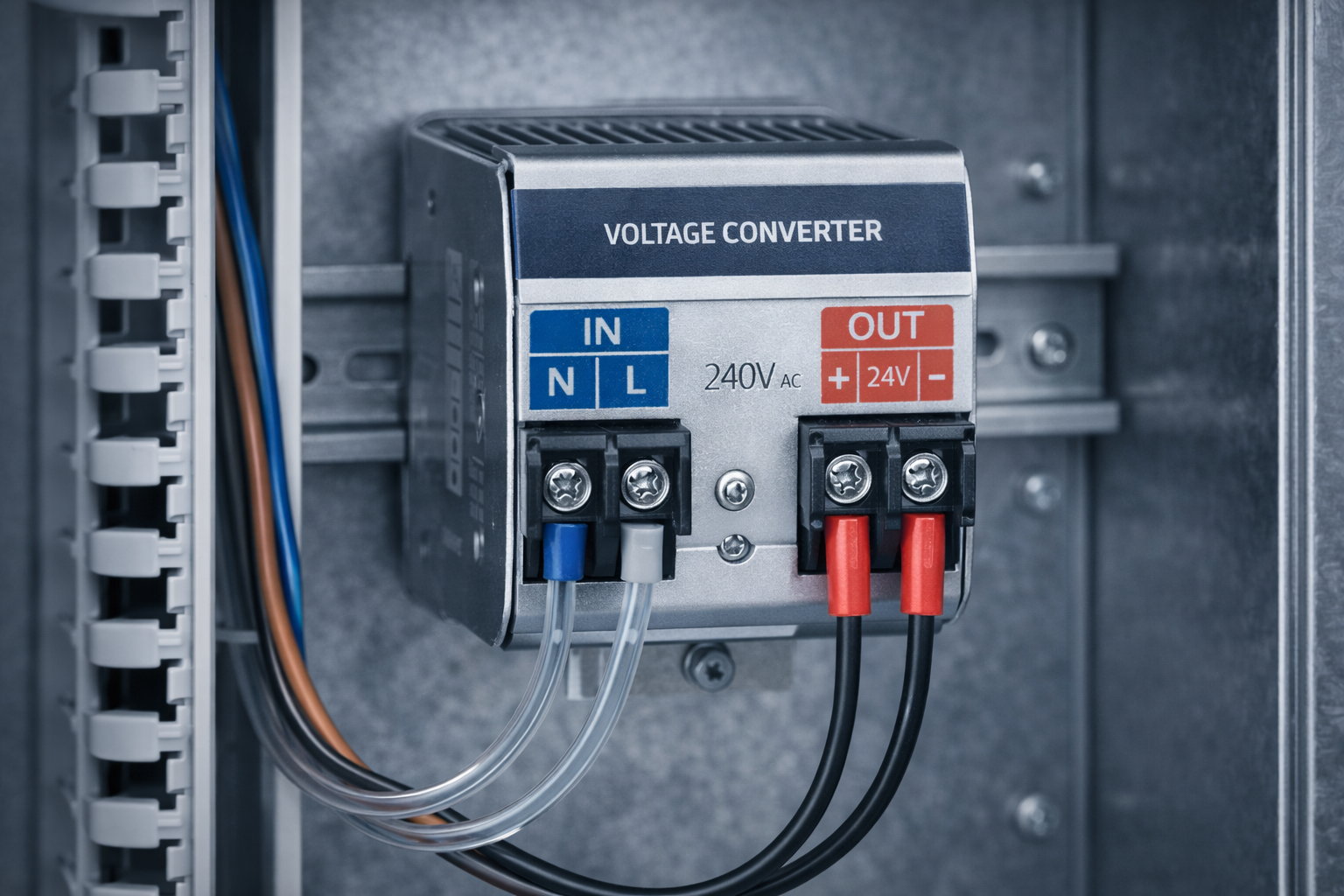
A voltage converter (or power supply/transformer) is an electrical component that steps down, steps up, or rectifies power from one format to another.
In the HVAC and building automation industry, they are typically used to step high mains voltage down to the safe, low voltages required by BMS controllers, sensors, and field devices.
Common Scenarios for Voltage Conversion
1. Stepping Down 240VAC to 24VAC (The Standard Retrofit) Most modern building automation controllers and smart actuators—like those from Belimo or Siemens—run on 24V AC or DC. If you are retrofitting a plant room that previously relied on 240V pneumatic-electric hybrid controls, you must install a step-down transformer to provide a safe 24VAC power bus for your new Valve Actuators.
2. Converting 24VAC to 24VDC (Rectification) While many HVAC actuators will accept both 24V AC and DC, certain specialized sensors (especially some older 4-20mA loop-powered transmitters) strictly require 24V Direct Current (DC). If your main control panel only has a 24VAC transformer, you need a DC converter module to rectify the AC power into a clean DC output for these sensitive instruments.
3. Isolating Control Circuits Even if the voltage matches, isolation transformers or specific converters are sometimes used to electrically isolate a sensitive BMS controller from "noisy" field devices like large contactors or VSDs, preventing electrical feedback from crashing the microprocessor.
How to Size Your Voltage Converter
When selecting a Power Supply or voltage converter, you must calculate the total load of the devices it will power.
- Check the VA Rating: Add up the Volt-Ampere (VA) or Wattage ratings of all the controllers, sensors, and actuators connected to the circuit.
- Account for Inrush: Actuators (especially spring-return models) can draw significantly more power when they first start moving than when they are resting. Always size your converter or transformer with at least a 20-30% safety margin to handle this inrush current.
Available at Controls Traders
Wiring mismatched voltages is one of the most common causes of equipment failure during commissioning. Ensuring you have the correct power conditioning equipment is critical.
Controls Traders, based in Adelaide, stocks a wide range of Voltage Converters and DIN-rail mountable power supplies suited for industrial HVAC environments.
Explore our full range of Switches & Electrical products online, and enjoy fast, Australia-wide shipping on all orders.
Frequently Asked Questions
What is the difference between a transformer and a voltage converter in HVAC?
In HVAC, these terms are often used interchangeably, but technically a transformer steps voltage up or down while keeping the power as AC (e.g., 240VAC to 24VAC). A voltage converter is a broader term that can also include DC power supplies (rectifiers), which convert AC to DC. Most BMS panels use both — a step-down transformer to create a 24VAC bus, and DC power supply modules for devices that require 24VDC.
How do I calculate what size transformer or power supply I need?
Add up the VA (Volt-Ampere) or Watt ratings of all devices the transformer will power — controllers, actuators, sensors, relays. Then add a 20–30% safety margin to handle actuator inrush current when spring-return models first energize. For example, if your total device load is 80VA, select a transformer rated for at least 100–120VA. Undersizing is one of the most common causes of BMS panel faults during commissioning.
Can I run both 24VAC and 24VDC devices from the same transformer?
You can run a DC converter module off the same transformer to derive 24VDC from the 24VAC bus, but the two circuits should be electrically isolated. Mixing AC and DC on the same wiring terminals will damage 24VDC-only devices. Always use separate terminal rails and clearly label AC and DC circuits in your panel documentation.
What is electrical isolation and when is it needed in HVAC panels?
Electrical isolation separates two circuits so that electrical noise or faults in one cannot affect the other. It is commonly used to protect sensitive BMS microprocessors from noise generated by large contactors, variable speed drives, or inductive loads switching on and off nearby. An isolation transformer or an optically isolated DC supply module provides this protection.
Where can I buy HVAC voltage converters and power supplies in Australia?
Controls Traders stocks a full range of voltage converters and power supplies suited for HVAC control panel applications from our Adelaide warehouse, with fast Australia-wide delivery. Call 1300 740 140 for sizing advice or browse our Switches & Electrical catalogue online.
Leave a comment
Popular Posts
A Practical Guide to Actuator Selection for HVAC Applications
Spring-Return vs Non-Spring-Return Actuators: Which Do You Need?
PICV Sizing and Selection Guide for HVAC Systems