










Common HVAC Sensor Types Explained
In any Building Management System (BMS), the controller acts as the brain, but the sensors serve as the vital nervous system. Regardless of how advanced your digital controls are, they cannot maintain occupant comfort or optimize energy efficiency if they receive inaccurate data from the field.
At Controls Traders, based in Adelaide, South Australia, we have over 40 years of industry experience supplying high-quality Sensors & Transducers. To help facility managers and HVAC technicians navigate system upgrades, here is our technical breakdown of the most common HVAC sensor types and their applications.
1. Temperature Sensors
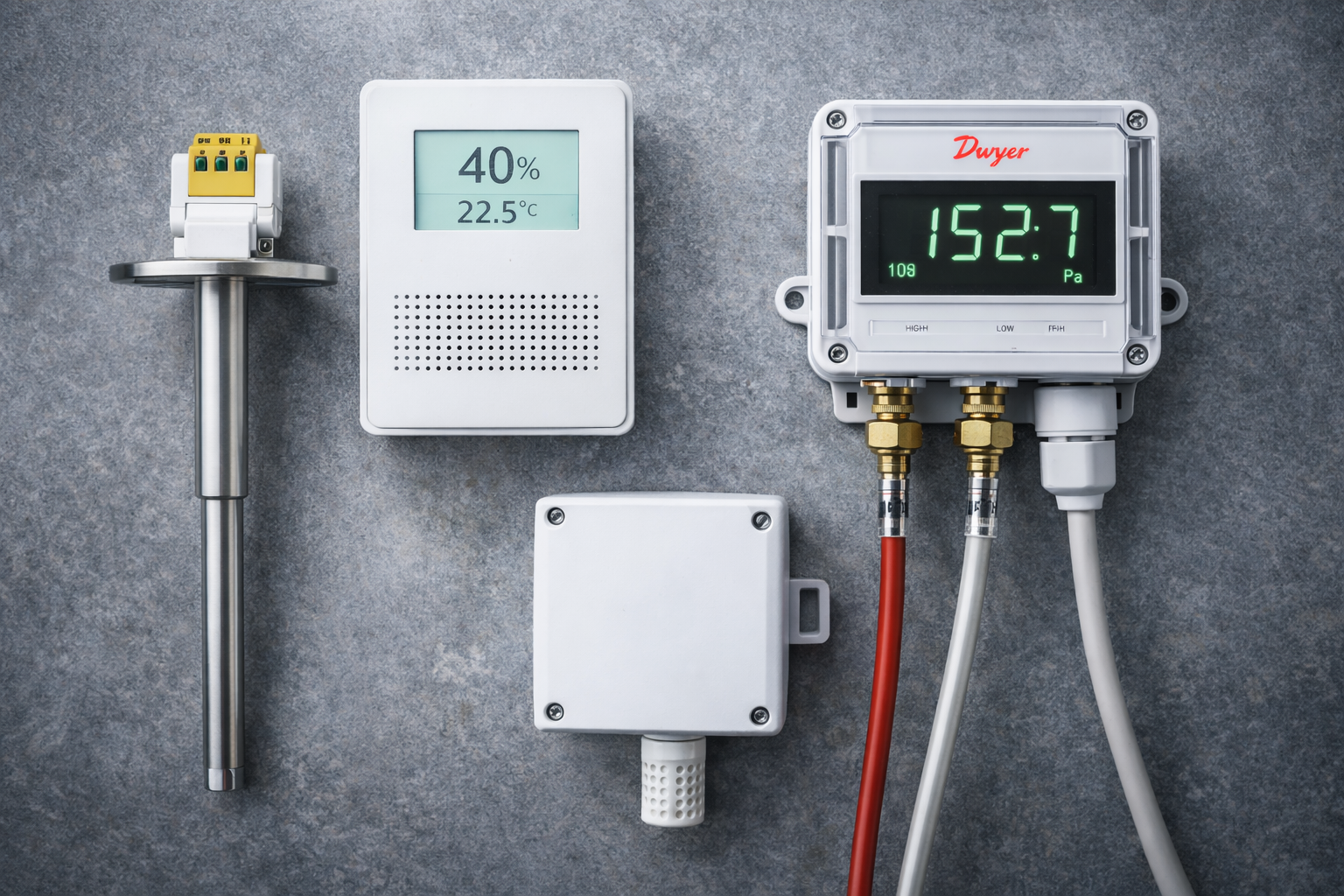
Temperature sensors are the primary variable for roughly 90% of HVAC control loops. Most standard BMS applications utilize Thermistors (such as 10k Type 2 or 10k Type 3), which are cost-effective and highly sensitive to temperature changes. For critical process control, central plant supplies, or thermal energy calculation, RTDs (like PT100 or PT1000) are used because they offer extreme stability and linear accuracy.
Depending on where you are measuring the temperature, you will need a specific form factor:
- Room Sensors: These aesthetic, wall-mounted units provide fast responses to occupant loads in office VAV zones.
- Duct Sensors: Available as rigid probes for small ducts or flexible averaging elements for large AHU mixed-air plenums. Averaging sensors are critical in AHUs to prevent the BMS from reacting to isolated streaks of cold outside air.
- Pipe Sensors: Immersion sensors sit inside a stainless steel or brass thermowell directly in the water flow, providing the highly accurate readings required for chiller supplies. Strap-on variants are also available for retrofits where the system cannot be drained.
- Outside Sensors: Built with weatherproof enclosures and sun-shields to ensure solar radiation does not artificially inflate the ambient air reading.
2. Indoor Air Quality (IAQ): CO₂ and Humidity Sensors
Modern HVAC design relies heavily on Demand Control Ventilation (DCV), where outside air intake is strictly matched to building occupancy.
- CO₂ Sensors: By measuring carbon dioxide levels, these sensors tell the BMS exactly how many people are in a room. If a meeting room is empty, the BMS signals the system to reduce fresh air intake, saving significant energy on conditioning outside air. For accurate readings, CO₂ sensors must always be installed at breathing-zone height (1.2m–1.5m) and kept away from supply air diffusers.
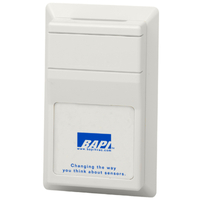
- Humidity Sensors: Proper humidity control is critical for occupant comfort and preventing mold in commercial spaces. Today, humidity sensing is often conveniently combined with temperature and CO₂ monitoring in a single multi-function room unit, such as those manufactured by Siemens or BAPI.
3. Differential Pressure (DP) Sensors
A Differential Pressure Transducer measures the difference in pressure between two distinct points (a high side and a low side) and converts that mechanical difference into an electrical signal (like 0-10V) for the BMS.
DP sensors generally fall into two categories:
- Air DP Sensors (Dry Media): Essential for airside operations, these measure in Pascals (Pa). They are used for filter monitoring (triggering a "Dirty Filter" alarm as pressure drops across a clogged filter bank), monitoring duct static pressure to tell Variable Speed Drives (VSDs) to speed up or slow down, and ensuring safe building pressurization in stairwells.
- Liquid DP Sensors (Wet Media): These measure pressure drops across pumps, chillers, and valves, typically reading in kPa or Bar. They are crucial for maintaining proper hydraulic stability in chilled water and heating water loops.
Sourcing the Right Sensors in Australia
Using an incorrect sensor type or suffering from poor placement can lead to system "hunting," massive energy waste, and uncomfortable tenants.
If you need to replace a drifting sensor or specify parts for a new digital controls upgrade, Controls Traders stocks a comprehensive range of sensors from industry-leading brands, including BAPI, Siemens, Automated Components Inc (ACI), and Dwyer.
We warehouse our inventory locally in Adelaide, ensuring that you don't have to wait weeks for international freight. Browse our full range of Sensors & Transducers online or call our technical support team on 1300 740 140 for expert selection advice and fast, Australia-wide delivery.
Frequently Asked Questions
What is the most common type of temperature sensor used in HVAC?
The 10k Type 2 (10k-2) thermistor is the most widely used temperature sensor in commercial HVAC and BMS applications. It is cost-effective, highly sensitive, and natively supported by almost every major DDC controller brand including iSMA, Siemens, Schneider, and EasyIO. Controls Traders stocks a full range of 10k-2 sensors from BAPI and ACI for same-day dispatch from Adelaide.
What is the difference between a thermistor and an RTD?
A thermistor (like the 10k-2) is highly sensitive and inexpensive, making it ideal for standard zone control in offices and AHUs. An RTD (Resistance Temperature Detector), such as a PT100 or PT1000, is more accurate and stable across a wide temperature range, making it better suited for critical applications like chiller supply monitoring or thermal energy metering. RTDs cost more but are essential where precise measurement is non-negotiable.
Where should a CO₂ sensor be installed in a room?
CO₂ sensors must be installed at breathing-zone height — between 1.2m and 1.5m above floor level — and positioned away from supply air diffusers. Placing a sensor directly under a diffuser will cause it to read artificially low CO₂ levels (because it is sampling diluted supply air), tricking the BMS into thinking the room is empty and reducing fresh air intake when it should not.
What is the difference between a room sensor and a duct sensor?
A room sensor is a wall-mounted unit that measures the ambient conditions in the occupied space — it is designed for airflow exposure and fast response to occupant heat loads. A duct sensor is a probe mounted inside the ductwork to measure supply air, return air, or mixed air temperatures. Averaging duct sensors are used in large AHU plenums where a single-point probe would not capture a representative reading across the full duct cross-section.
What causes a differential pressure sensor to give incorrect readings?
The most common causes are: incorrect port connection (high and low ports swapped), blocked or kinked pneumatic tubing, the sensor being mounted in a location exposed to vibration, or selecting a sensor with the wrong pressure range for the application. For filter monitoring, a 0–250 Pa range sensor is typically correct. For duct static pressure, a 0–500 Pa or 0–1000 Pa range is usually more appropriate depending on the system design.
Leave a comment
Popular Posts
A Practical Guide to Actuator Selection for HVAC Applications
Spring-Return vs Non-Spring-Return Actuators: Which Do You Need?
PICV Sizing and Selection Guide for HVAC Systems