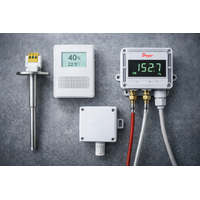











Advanced Troubleshooting: Common Symptoms of Faulty HVAC Sensors
In a Building Management System (BMS), your mechanical plant is only as smart as the data it receives. If a chiller plant receives bad data from a faulty return water sensor, it will operate inefficiently—no matter how advanced the controller logic is.
When building occupants complain about stuffy rooms or freezing drafts, the mechanical equipment is often blamed first. However, the root cause is frequently sensor failure.
At Controls Traders, we supply premium Sensors & Transducers across Australia. Drawing on our 40 years of experience, here is an advanced troubleshooting guide to identifying the symptoms of faulty HVAC sensors.
Symptom 1: Massive Temperature Offsets (-40°C or +120°C)
If your BMS is suddenly reading an impossible temperature (like -40°C in an office or +120°C in a chilled water line), the issue is almost certainly electrical, not environmental.
The Cause:
- Open Circuit / Short Circuit: For standard 10k thermistors, an open circuit (a cut wire) will typically read at the extreme bottom of the controller's scale (e.g., -40°C). A short circuit (wires touching) will read at the absolute maximum.
- Sensor Type Mismatch: If a technician wires a 10k Type 3 sensor into a controller programmed to read a 10k Type 2 curve, the temperature offset will be severe. Always verify the thermistor curve matches the software configuration.
Symptom 2: Sluggish or "Hunting" Control Loops
If the room temperature swings wildly from hot to cold, or the chilled water supply temperature oscillates, the sensor may be suffering from thermal lag.
The Cause:
- Missing Thermal Paste: If a pipe immersion sensor is placed into a thermowell without thermal conductive paste, the air gap acts as an insulator. The water temperature changes, but the sensor takes 15 minutes to register it, causing the controller to overreact.
- Poor Placement: A Room Sensor mounted behind a bookshelf or a Duct Sensor placed in a dead-zone of the AHU will not see the airflow, resulting in sluggish response times.
Symptom 3: CO₂ and Humidity "Drift"
Unlike standard thermistors (which rarely drift), Indoor Air Quality (IAQ) sensors—like CO₂ and Humidity transducers—contain active sensing elements that can degrade or drift over time.
The Cause:
- Loss of Calibration: If the VAV box is pumping in 100% outside air but the room is empty, the CO₂ sensor has likely drifted upwards. High-quality sensors (like those from BAPI or Siemens) feature Automatic Background Calibration (ABC) to re-zero themselves based on overnight baseline levels. If a building is occupied 24/7, this ABC logic can fail, requiring manual calibration or replacement.
- Contamination: Humidity sensors placed in aggressive environments (like pools or outside air intakes) can suffer from chemical or moisture contamination on the sensing polymer, skewing the relative humidity reading permanently.
What to Do When a Sensor Fails
If a sensor has drifted beyond repair or suffered water ingress, it must be replaced to restore building efficiency.
Standardizing your site with reliable, high-quality sensors from reputable brands reduces the frequency of these service calls. Controls Traders warehouses a massive inventory of Sensors & Transducers locally in Adelaide.
Whether you need a replacement duct probe or a highly accurate room unit, we offer fast shipping Australia-wide. Call our support team on 1300 740 140 for cross-referencing and technical advice.
Frequently Asked Questions
How do I know if my HVAC temperature sensor has an open circuit or short circuit?
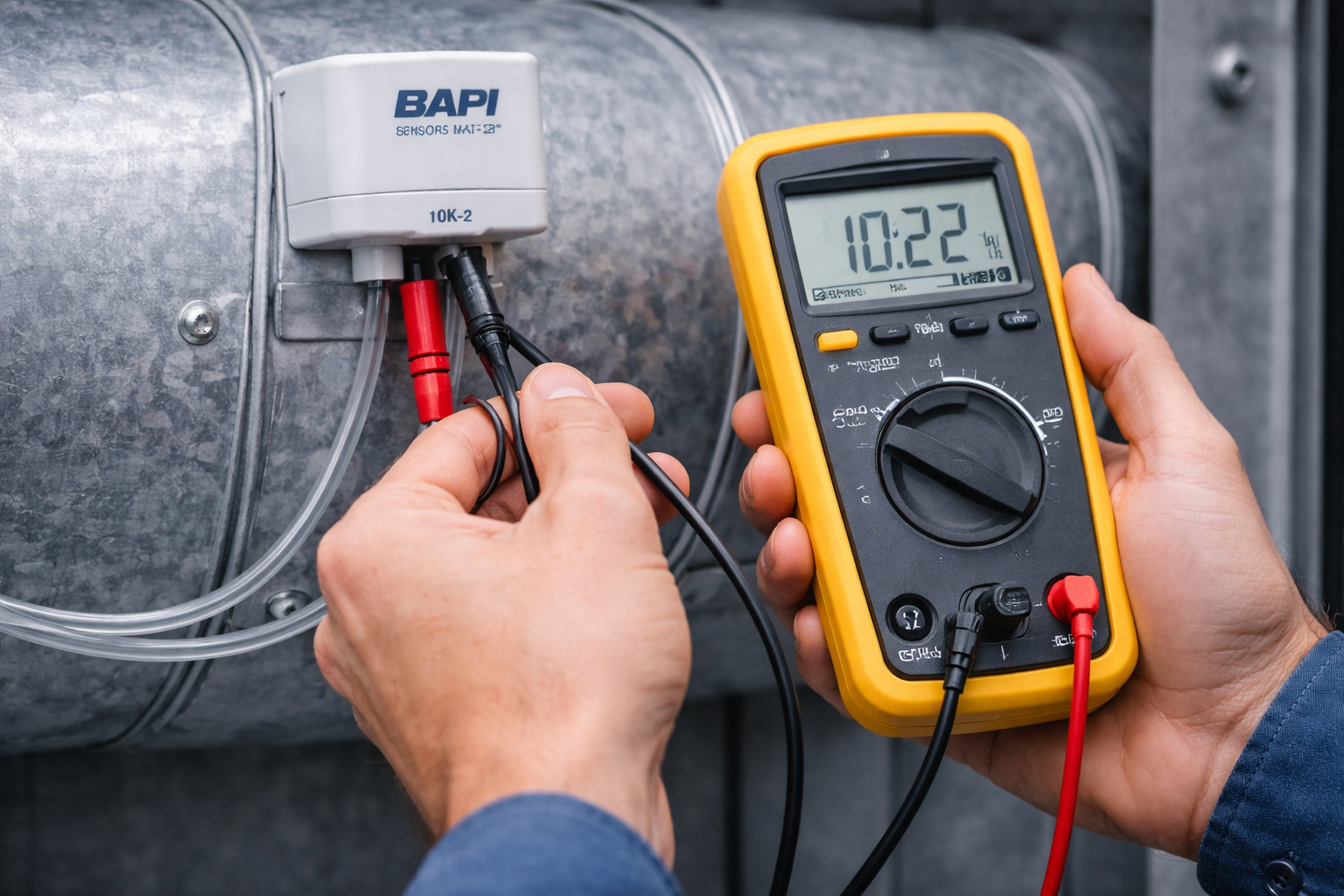
For a 10k thermistor, use a multimeter set to resistance (ohms). At room temperature (~25°C), a healthy 10k-2 sensor will read approximately 10,000 ohms. A reading of OL (overload/infinite resistance) indicates an open circuit — the wire or sensor element is broken. A reading of near 0 ohms indicates a short circuit — the wires are touching. Both faults produce extreme temperature readings on the BMS (typically -40°C or maximum scale).
What is Automatic Background Calibration (ABC) in CO₂ sensors?
ABC is a self-calibration feature in CO₂ sensors that assumes the lowest CO₂ reading recorded over a rolling period (typically 1–2 weeks) represents clean outdoor air (~400 ppm). The sensor uses this baseline to correct for drift. ABC works well in buildings that are regularly unoccupied overnight. However, in buildings occupied 24/7 — like hospitals or data centres — CO₂ never drops to baseline, and ABC logic will gradually drift the calibration upward, requiring manual recalibration or replacement.
Why does my room temperature sensor read correctly at times but drift at others?
Intermittent readings usually point to a loose connection or a partially broken wire that makes and breaks contact with vibration or temperature changes. Check terminal screws at both the sensor and controller ends first. If wiring checks out, the thermistor bead itself may have a hairline fracture — common in older sensors that have experienced physical shock — and the sensor will need replacing.
Can a humidity sensor be repaired after moisture or chemical contamination?
Generally no. Humidity sensors use a polymer film that absorbs and releases moisture to measure relative humidity. Chemical contamination or prolonged exposure to saturated air (RH > 95%) permanently alters the polymer, skewing the reading. Some manufacturers offer a bake-out recovery process for mild contamination, but in most cases, a contaminated humidity sensor must be replaced. Controls Traders stocks replacement room sensors with integrated humidity sensing for fast dispatch from Adelaide.
How often should HVAC sensors be recalibrated or replaced?
Standard thermistors (10k-2) rarely need recalibration and can last 15+ years if installed correctly. CO₂ sensors typically require recalibration every 2–3 years and replacement every 5–7 years depending on the environment. Humidity sensors in clean indoor environments can last 7–10 years, but those exposed to outdoor air, pool environments, or chemical fumes may need replacement every 2–3 years. Differential pressure sensors should be verified annually against a calibrated reference.
Leave a comment
Popular Posts
Advanced Troubleshooting: Common Symptoms of Faulty HVAC Sensors
A Technical Guide to the Siemens RDF300 Room Sensor
How HVAC Flow Meters Improve Chilled Water System Efficiency