










Where to Place a CO₂ Sensor in an Open-Plan Office
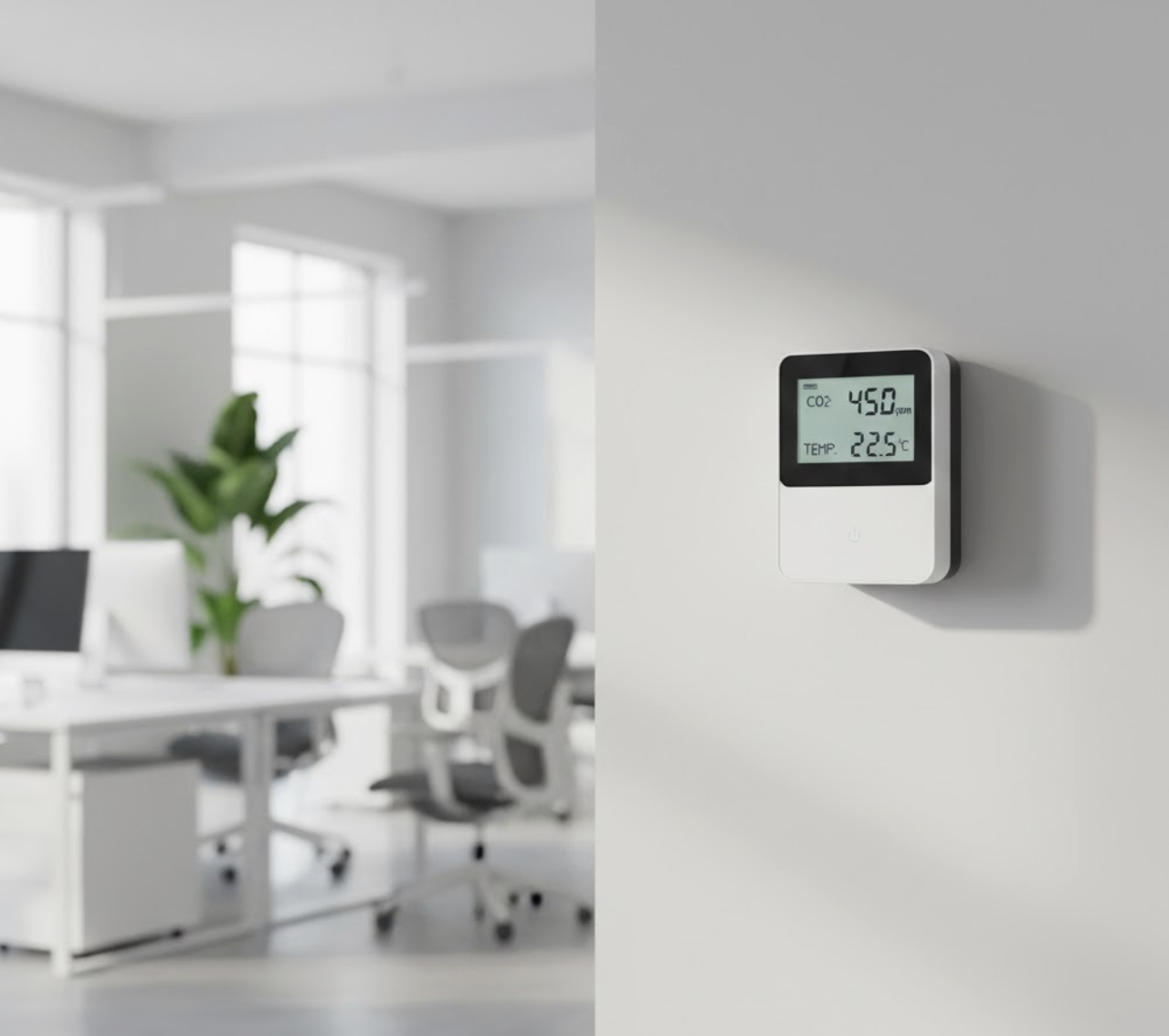
For HVAC installers and BMS technicians, the "set and forget" approach to sensor installation is a relic of the past. In modern Demand Control Ventilation (DCV) strategies, the CO₂ sensor is the heartbeat of the system.
If a temperature sensor is off by a degree, someone puts on a jumper. If a CO₂ sensor is poorly placed, the BMS either drastically under-ventilates (causing high PPM, drowsiness, and NCC compliance issues) or over-ventilates (pulling in unconditioned outside air and destroying energy efficiency).
At Controls Traders, backed by over 40 years of industry experience, we know that the sensor is only as good as its location. This guide covers the technical best practices for placing CO₂ sensors in open-plan offices to ensure accurate Indoor Air Quality (IAQ) monitoring.
In short, correct CO₂ sensor placement in an open-plan office is critical because it:
1. Ensures the BMS responds to actual occupant CO₂ levels, not diluted or stagnant air.
2. Prevents over- or under-ventilation that impacts indoor air quality and energy efficiency.
3. Enables effective demand-controlled ventilation in VAV and fan coil systems.
1. Why CO₂ Placement Matters
In a VAV (Variable Air Volume) or fan coil system, the CO₂ reading directly influences the damper position. The goal is typically to maintain indoor CO₂ levels below 800–1000 ppm (parts per million).
If a sensor is placed in a "dead zone" where air doesn't circulate, it may read 600 ppm while the occupied zone is hitting 1200 ppm. Conversely, placing a sensor directly in the path of supply air will result in artificially low readings, tricking the BMS into shutting down fresh air intake when it is needed most. Correct placement ensures the BMS reacts to the actual load generated by the occupants.
2. How CO₂ Behaves in Open Spaces
Unlike temperature, which equalizes relatively quickly, CO₂ is a heavy gas generated by point sources (people). In a calm open-plan office, CO₂ tends to pool around occupants before diffusing into the general return air path.
However, office air is rarely still. The HVAC system creates currents. Therefore, the sensor must be placed where it captures the mixed air representative of the breathing zone, not a stagnant pocket or a diluted airstream.
3. Best-Practice Placement Guidelines
The "Golden Rule" of sensor placement is to measure the air that people are actually breathing.
- Height: The sensor should be mounted at the breathing zone height.
- Distance: Keep sensors away from corners where air creates eddies/dead spots.
- Coverage: Ensure the sensor is centrally located relative to the zone it controls.
4. Height, Wall Positioning, and Airflow
Vertical Placement (Height)
For an open-plan office where occupants are mostly seated, the sensor should be mounted between 1.2m and 1.5m from the finished floor. This aligns with the seated breathing height and is generally consistent with light switch height for ease of cabling.
Avoid: Ceiling mounting for open-plan control sensors. While ceiling sensors are common, CO₂ concentration at the ceiling (near the return plenum) can differ significantly from the breathing zone, especially in high-ceiling spaces or systems with poor mixing.
Wall Selection
Mount the sensor on an internal column or partition wall. Avoid: External walls. Although modern sensors often have temperature compensation, external walls act as thermal bridges. If you are using a combined Temp/CO₂ unit (like those from Sensors & Transducers ranges), the radiant cold or heat from an external wall will skew the temperature reading, even if the CO₂ reading is acceptable.
5. Avoiding False Readings
Installers often compromise on location to save cabling time. Avoid these three common "sensor killers":
- Supply Air Wash: Never place the sensor within 1.5m to 2m of a supply air diffuser. The sensor will read the clean supply air (approx 400ppm) rather than the room air, causing the fresh air dampers to throttle down incorrectly.
- Doorways & Corridors: Do not mount sensors next to main entry doors or in corridors. Drafts from opening doors or unconditioned hallways will cause erratic spikes and dips in the BMS data logs.
- Direct Sunlight: Direct UV exposure can degrade plastic housings and affect the infrared (NDIR) components used in high-quality sensors.
6. How Many Sensors Do You Need?
A single sensor cannot effectively monitor a 500sqm floor plate.
- Zone-Based approach: Ideally, install one sensor per VAV zone. If one VAV box serves a distinct cluster of desks, that cluster needs its own sensor.
- Radius approach: As a general rule of thumb for open spaces, one sensor covers approximately 70m² to 100m², provided there are no full-height partitions blocking airflow.
7. Common Mistakes Installers Make
- The "Breath Test" Error: Installing a sensor directly behind a dedicated workstation (e.g., right next to a receptionist's head). If one person exhales directly onto the sensor, the BMS may ramp up the plant for the whole zone based on one person's coffee breath.
- The Return Air Duct Trap: Relying solely on duct-mounted sensors in the main return air shaft. While useful for general building monitoring, duct sensors measure an average of the whole floor. They cannot detect that Meeting Room B is full of people and suffocating while the rest of the office is empty. Room-level sensing is superior for DCV.
8. Example Layout Scenario
Scenario: A 100m² open-plan zone with 10 desks and south-facing windows.
- Bad Placement: On the external south wall (thermal issues) or on the ceiling directly between two supply diffusers (short-cycling).
- Good Placement: On an internal structural column in the center of the desk cluster, mounted at 1.5m high. This captures the mixed air from the occupants without being influenced by the supply air or the external wall temperature.
9. Conclusion and Recommendation
Correct CO₂ sensor placement is the difference between an efficient, compliant building and one that generates constant "it's stuffy in here" complaints.
Always aim for the breathing zone (1.2m–1.5m), use internal walls, and ensure one sensor per mechanical control zone.
At Controls Traders, we stock a wide range of reliable HVAC Room Sensors and combined units from trusted brands like Siemens, BAPI, and Automated Components Inc (ACI).
Unsure which sensor fits your BMS specification? Read the full guide on our website for placement diagrams and product suggestions.
Leave a comment
Popular Posts
What Is a Pressure-Independent Control Valve (PICV)?

Choosing the Right Temperature Sensor for Your BMS Setup

LoRaWAN vs BACnet MS/TP: Which Protocol Should You Use?