










How to Wire ACI Current Switches and Schneider 24VAC Relays
In commercial HVAC control panels, the Building Management System (BMS) relies on two critical functions to operate mechanical equipment safely: command (telling a device to start) and feedback (confirming it is actually running).
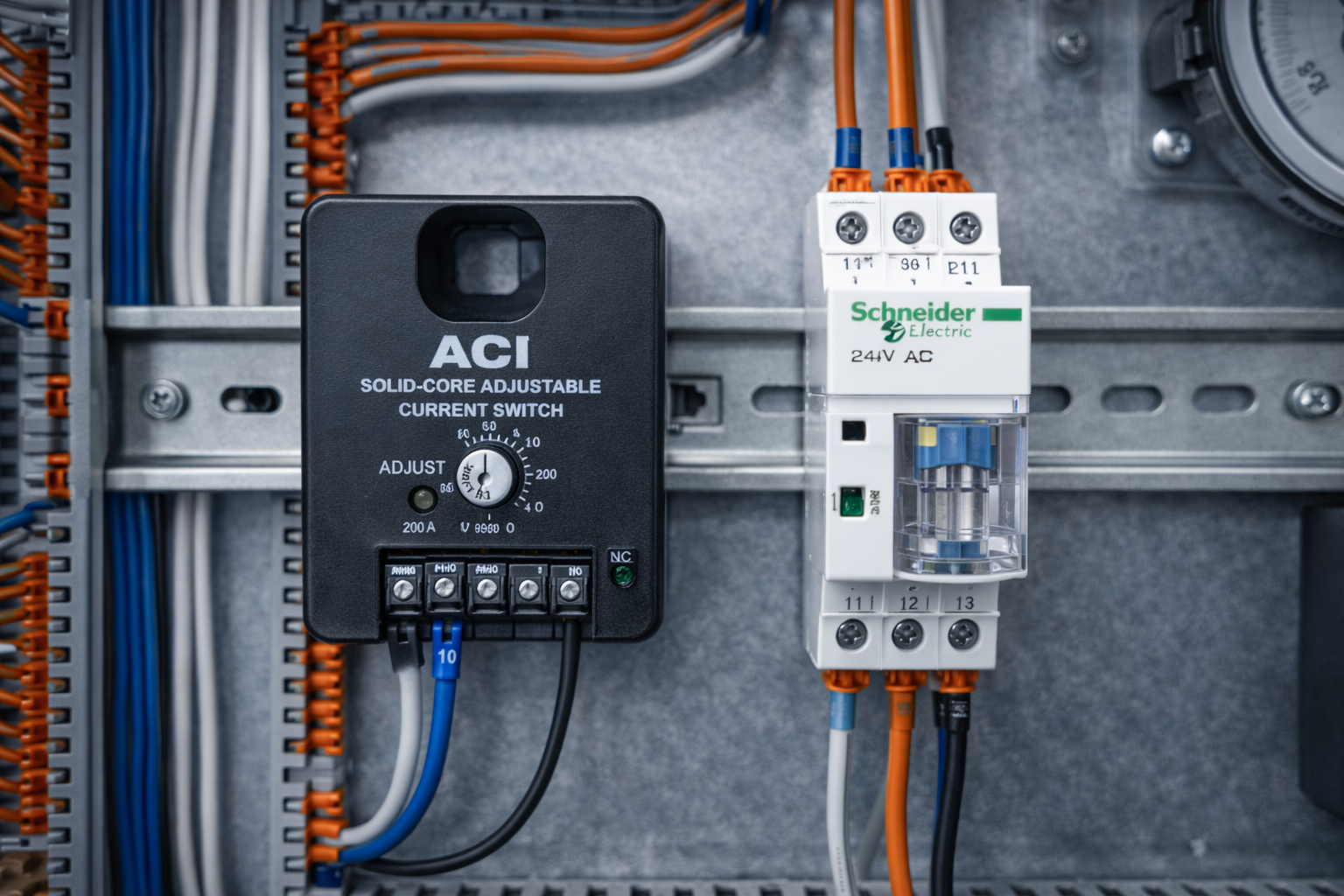
To achieve this, panel builders rely heavily on relays and current switches. At Controls Traders, we supply premium electrical components, including the highly sought-after Automated Components Inc (ACI) current switches and Schneider Electric relays.
Here is a practical guide on how these two essential components work together in a typical HVAC panel and best practices for wiring them.
The Role of the Schneider 24VAC Relay (The Command)
A BMS controller typically outputs a low-voltage (24VAC or 24VDC) signal. However, the exhaust fan or pump you want to start likely requires 240VAC or 415VAC. You cannot wire a high-voltage fan directly to a low-voltage controller without destroying it.
The Schneider 24VAC 2-Pole Relay acts as the isolation bridge.
- How it works: The BMS sends a 24VAC signal to the relay coil. This electromagnetically pulls the contacts closed.
- The Wiring: The high-voltage field wiring (e.g., the 240V fan start circuit) is wired through the "Normally Open" (NO) contacts of the relay. When the BMS energizes the relay, the high-voltage circuit completes, and the fan starts.
- Why Schneider? Schneider Electric relays are known for their industrial durability and reliable DIN-rail mounting bases, making panel layouts clean and easy to troubleshoot.
The Role of the ACI Current Switch (The Feedback)
Just because the BMS commanded the relay to close does not mean the fan is moving air. A belt could be snapped, or a local isolator could be turned off. This is where "Proof of Flow" is required.
The ACI Solid Core Adjustable Current Switch provides this proof.
- How it works: You pass one of the live high-voltage wires feeding the fan motor through the center (the "core") of the ACI current switch. The switch senses the magnetic field generated by the current flowing to the motor.
- The Wiring: The output terminals of the ACI switch are wired back to a Digital Input (DI) on the BMS controller.
- Adjustable vs. Fixed: An adjustable current switch is highly recommended because you can dial in the exact amperage threshold. If a fan belt snaps, the motor still spins but draws less current (because there is no load). By calibrating the ACI switch to trip just below the normal operating load, the BMS will instantly detect the broken belt and trigger an alarm.
Best Practices for Panel Builders
- Keep Voltages Separated: Always physically separate your low-voltage BMS wiring from your 240V/415V field wiring inside the panel to prevent electrical interference and ensure technician safety.
- Use DIN Rail Organization: Mount your Relays and any necessary 24V Power Supplies cleanly on DIN rails.
- Looping for Low Amperage: If the motor you are monitoring draws a very small amount of current (e.g., less than the minimum sensing threshold of the ACI switch), you can loop the live wire through the solid core two or three times to artificially multiply the current reading.
Source Your Electrical Controls Locally
Sourcing reliable control panel parts shouldn't hold up your manufacturing schedule. Controls Traders, based in Stepney, South Australia, warehouses a massive range of Switches & Electrical components.
Whether you need a box of Schneider relays or ACI adjustable current switches, we offer fast, Australia-wide delivery. Browse our range online or call us on 1300 740 140 for project pricing.
Frequently Asked Questions
What is the difference between a relay and a contactor in HVAC control panels?
A relay is a smaller switching device typically used for low-to-medium current loads — such as starting a single fan or signalling a control circuit. A contactor is a heavier-duty switching device designed for high-current loads like large motors, chillers, or three-phase pump starters. In BMS panels, relays handle the command interface between the low-voltage controller and the high-voltage field circuit, while contactors are usually found in the motor control centre (MCC).
Why use an adjustable current switch instead of a fixed one?
An adjustable current switch lets you set the exact amperage trip point to match the motor’s normal operating load. This is critical for detecting broken belts — a fan motor with a snapped belt still spins and draws current, but at a lower level than normal. A fixed switch may not detect this subtle drop, whereas an ACI adjustable current switch can be calibrated to trip below the unloaded motor current, triggering an alarm immediately.
Can I use the same relay for both 24VAC and 24VDC?
Not necessarily — relay coils are rated for specific voltage types. A relay rated for 24VAC may not pick up reliably on 24VDC, and vice versa. Always check the coil voltage specification on the relay datasheet before wiring. Controls Traders stocks both AC and DC variants of common HVAC relays — call 1300 740 140 to confirm the correct model for your application.
How do I loop a wire through an ACI current switch for low-amperage motors?
If the motor draws less current than the minimum sensing threshold of the ACI switch, simply loop the live supply wire through the solid core multiple times. Each additional loop effectively multiplies the sensed current by the number of passes. For example, three loops through the core triples the apparent current reading, allowing the switch to detect very small motors reliably.
Where can I buy ACI current switches and Schneider relays in Australia?
Controls Traders stocks ACI adjustable current switches and Schneider Electric relays from our Adelaide warehouse for fast Australia-wide delivery. Browse our Switches & Electrical range online or call 1300 740 140 for bulk project pricing.
Leave a comment
Popular Posts
How to Wire ACI Current Switches and Schneider 24VAC Relays
The Complete Guide to BAPI 10K-2 Sensors: Room, Duct, and Immersion
Advanced Troubleshooting: Common Symptoms of Faulty HVAC Sensors