











How to Size a Valve Actuator for Chilled-Water Coils
.png)
For building automation technicians and HVAC installers, an undersized actuator is a nightmare. It leads to "hunting," leaking valves, and chilled water bypass that kills your Delta T and inflates energy costs. Conversely, an oversized actuator can strip gears or snap valve stems.
Getting the sizing right is critical for the stability of your chilled water (CHW) loops. Whether you are retrofitting an old plant room in Adelaide or commissioning a new BMS in Sydney, the physics remain the same.
At Controls Traders, we have over 40 years of industry experience supplying HVAC controls. This guide breaks down exactly how to size a valve actuator correctly for chilled water applications.
1. Identify the Valve Movement Type
Before looking at torque ratings, you must match the actuator’s motion to the valve body.
- Rotary Motion (Quarter-Turn): Required for Ball Valves and Butterfly Valves. Force is measured in Torque (Newton Meters - Nm).
- Common Application: Isolation valves or control valves in newer installs.
- Go-To Brand: Belimo Actuators are the industry standard here, with rotary ranges typically spanning 2Nm to 40Nm, and up to 160Nm for large butterfly valves.
- Linear Motion: Required for Globe Valves. Force is measured in Thrust (Newtons - N).
- Common Application: Precision control in AHUs and older chiller plant retrofits.
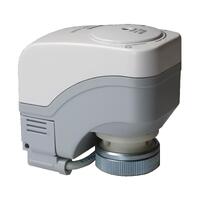
- Go-To Brand: Siemens Actuators excel here. We stock the Siemens SAX Series, which delivers up to 800N of force, ideal for handling high differential pressures in large globe valves.
2. Calculate the Close-Off Pressure
This is the step most often skipped, leading to valve leakage. The actuator must be strong enough to close the valve completely against the system's pump pressure.
You need to know the Maximum Differential Pressure (ΔPmax) the valve will experience when fully closed.
The Calculation Logic:
- Check the Valve Datasheet: Look for the "Close-Off Pressure" rating of the valve body.
- Check the System Pressure: What is the pump head pressure? In a worst-case scenario (all other valves closed), your actuator must overcome the full pump head to keep the valve shut.
- Apply a Safety Factor: We recommend adding a 20-30% safety margin to your torque/force calculation to account for seat friction, debris, and age.
Pro Tip: If you are using a Pressure Independent Control Valve (PICV), the sizing is often simpler as the differential pressure is managed mechanically by the valve cartridge, but you must still ensure the actuator torque matches the specific valve body requirements.
3. Select the Control Signal
For chilled water coils, you generally need precise temperature control to maintain occupant comfort and efficiency.
- Modulating (0–10V or 4–20mA): This is the standard for CHW coils. It allows the BMS to open the valve to exactly 45% (for example) rather than just 0% or 100%. This prevents "hunting" and stabilizes room temperature.
- On/Off (2-Position): Generally used only for isolation valves, not coil control.
- 3-Point (Floating): Common in older systems but less precise than 0-10V.
Note: Most modern Schneider and Belimo actuators feature DIP switches or NFC programming (via smartphone apps) to switch between 0-10V and 4-20mA signals during commissioning.
4. Determine Fail-Safe Requirements
In a power outage, where does the valve need to go?
- Spring Return (Fail-Safe): A mechanical spring forces the valve open or closed when power is cut. For chilled water coils, this is often "Fail Closed" to prevent flooding the coil or over-cooling the building.
- Example: We stock Belimo spring-return models that can drive a valve to a safe position within 75 seconds.
- Non-Spring Return (Fail-in-Place): The valve stays in its last position. This is cheaper but risky for critical zones like computer rooms or operating theatres.
5. Quick Sizing Guide by Brand
Based on our inventory at Controls Traders, here is a quick reference for matching actuators to common applications:
| Application | Valve Type | Recommended Actuator | Key Specs |
| VAV / Small Zone | Small Ball Valve (DN15-25) | Belimo Rotary | 2Nm - 5Nm Torque |
| AHU Coil Control | Ball Valve (DN32-50) | Belimo Rotary | 10Nm - 20Nm Torque |
| Central Plant | Large Globe Valve | Siemens Linear (SAX) | 800N Force |
| Tight Spaces | Damper/Valve Retrofit | Belimo Compact | Universal Clamp / NFC |
| Energy Monitoring | Control Valve | Belimo Energy Valve | Integrated Flow Meter + ΔT Logic |
6. The "Gotchas" of Sizing
Avoid these common installation mistakes:
- Oversizing: Putting a 20Nm actuator on a small DN15 valve that only needs 4Nm can snap the valve stem if the limit stops aren't set correctly.
- Voltage Mismatch: Double-check if your control panel is supplying 24V AC/DC or 230V. We stock Transformers and Power Supplies if you need to step down voltage.
- Linkage Kits: If you are retrofitting a new actuator onto an old valve body (e.g., putting a Belimo actuator on an old Honeywell valve), you may need a specific retrofit linkage kit.
Need Technical Advice?
Sizing actuators isn't always straightforward, especially with older Australian plant rooms.
At Controls Traders, we don't just shift boxes, we help you select the right part for the job. We warehouse stock locally in Adelaide, including Belimo, Siemens, Honeywell, and Schneider, and we ship Australia-wide.
Unsure about the torque requirements for your project? Send us a photo of the valve plate or the old unit. We can cross-reference it for you.
Request a Quote Online Or call our technical team on 1300 740 140.
Leave a comment
Popular Posts
What Is a Pressure-Independent Control Valve (PICV)?

Choosing the Right Temperature Sensor for Your BMS Setup

LoRaWAN vs BACnet MS/TP: Which Protocol Should You Use?